(This post was prompted by a discussion over at Locusts & Honey.)There are some people for whom theology is a set of propositions to which one may subscribe. If you subscribe to one set of propositions, you are a Christian. If you subscribe to another, you are Jewish. If you subscribe to another, you are a Muslim. And so forth. Even agnosticism and atheism fit in nicely here, as the subscription to their own respective sets of propositions about God.
For a Christian who has this mindset, evangelism seems to be a rather rudimentary process of comparing sets of propositions and ascertaining which set is “right” and which set is “wrong,” and convincing people to subscribe to the “right” one. The “right” set of propositions is almost always the set held by the one doing the evangelizing, which makes the set of propositions held by the object of evangelism, by definition, “wrong.”
So, the evangelist starts off telling their target, “You are wrong; I am right. The only way for you to get right with God is to stop subscribing to your set of propositions, which are wrong, and adopt mine, which are right.”
I don’t know about you, but that doesn’t sound like the most effective way to spread the good news to me. In my humble opinion, it’s not even very faithful. It leaves no room for wonder, or doubt, or imagination. It is buttoned down, girdled, caged, boxed-in thinking that, when taken to its logical extreme, does not allow for a whole lot of movement of the Spirit. Plus it’s just no fun at all.
To start out, theology is more than a set of propositions. Peter Hodgson (I think) says that theology is a kind of “creative fiction,” or a poetic retelling of that which we know to be true about God. (I’m paraphrasing.) Dovetailing this idea, I see theology as the art of describing God and God’s relationship with creation. It is less scientific than imaginative. Reducing it to a mere set of propositions is like hanging color-by-number paintings in an art gallery.
Secondly, Jesus did not say to his followers, “Go therefore and compare sets of propositions with all nations, convincing them that their sets are wrong and yours is right. And lo, I will be with you (and only you) always, till the end of the age.” No, he said, “Go and make disciples.” It’s about relationships, not doctrines. Jesus seems to care a whole lot more about how we treat one another than about how we get other people to believe what we believe.
If you want to make a friend, you don’t try to convince them of how wrong their current friendships are and that they should abandon them in favor of being friends with you. You just treat them nice, show them some love, smile at them, help them out. If you want to introduce someone to Christ, you don’t recite orthodoxy at them and point out how wrong they are not to believe it. You just love them like Christ does.
Finally, it occurs to me that I don’t put as much stock in being right as some people do. There is a stagnancy to being right that is unappealing to me. If you’re right, there’s no room to grow. What, am I going to somehow get “righter” over time? Right and wrong are categories that do not often enter into my way of thinking.
It seems a little bit too deontological for me, too. I would much rather be considered faithful than right. My telos is faithfulness, and that guides my theological reflection in a way that being right never could. In that way, I am continually a work in progress/being perfected in love/in the process of becoming/working out my salvation with fear and trembling/emerging.
That’s what I think. But of course, I could be wrong.Update: John has posted a response: click here.
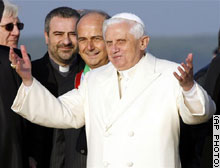
 Frank sent me a link to this full-lenght picture of the Pope Coat, which gives evidence that he is even super-flyer than we first suspected - Note the snazzy red shoes!And by the way, here is another hypothesis on why he wasn't all bedecked in Papal Regalia when he landed: Maybe it has to do with Turkey being a secular country in which it is the practice of the priests to not wear their priesty stuff in public? Anyway, I heard that in an NPR story, and it is at least as good an idea as the one about his cross setting off the airport metal detector and being confiscated!
 When the Pope landed in Turkey, he was wearing a super-fly white coat. (I am SO putting it on my Christmas list.) However, Shawn noticed he was wearing no cross, at least not apparent to the casual observer. Question is - why?
Maybe he didn’t want to look overtly Christian, thinking he might offend (or offend again, perhaps) the Muslims in Turkey?
Maybe he has a travel outfit that is more scaled down and doesn’t include all the Pope paraphernalia?
Maybe he left his cross in the overhead bin by mistake?
Maybe the cross set off the airport security alarm and they made him take it off?
Later he had the full outfit on, but when he first landed he definitely had a kind of different look about him. Here in the lobby of Drury Inn in Columbia, a few of us attending the Residents in Ministry meeting have been speculating about the theological implications of the Pope’s wardrobe. What do y’all think?
 See that enormous stack of paper?Those two VHS video tapes?That CD filled with my last couple of months' worth of sweat and toil?That's the stuff I'll be turning in, God willing, tomorrow afternoon in Columbia at the Missouri Conference office as one of the final steps in the process toward being ordained an Elder in the United Methodist Church. And, get this now - it will be there three days EARLY! That'll be a first for me, let me tell you!What an enormous relief! It's just a huge weight lifted off my back to have this released. It was a great process, really. I haven't had the opportunity to reflect deeply on my theology since seminary, and I was actually grateful for the opportunity. But nonetheless, it is a joy to have it done and away.Next step = interviews. But there's some time to pass before I have to get too stressed out about those. One step at a time!
Last week was extremely busy - two ecumenical Thanksgiving services at one of which my dad was the preacher, trying to cram a week's worth of church work into three days, two people hospitalized to visit, travel to Columbia, MO for Thanksgiving, then back to KC for the weekend worship services. Needless to say, blog time was limited at best.+++What do you do with complainers? The people who will find something bad to say about just about anything that happens drive me absolutely bonkers! One of my axioms for ministry is "Everyone needs something about which to bitch," and that holds true. BUT the question still remains how to react when the complainers take the floor. Currently, my philosophy is not to acknowledge their complaint at all unless they can make a well-reasoned and thoughtful argument in defense of their position. If they are just complaining, though, I basically just pretend they are my best friend in the world and smile an enormous smile and change the subject. Complainers are poisonous.
Maybe I should go to church here.+++ALL ORDINATION PAPERWORK IS DUE THIS FRIDAY!!! I think I'm in good shape, actually, with just a few bits and pieces to clean up. Of course, the Board of Ordained Ministry has scheduled a Residents In Ministry meeting this week - Tuesday noon through Wednesday noon - that will necessitate our all driving to the conference office in Columbia and back also, basically knocking two complete days out of our week. Timing is everything! Just out of Thanksgiving, Advent starting up, ordination paperwork due, be an effective pastor in your appointment, and, o yeah, by the way, spend two days away at a required meeting right in the middle of all that.Not that I'm complaining, mind you ... ;)
My son Wesley is sick. So today, I worked on my laptop at the kitchen table while he played quietly in the living room. While I was writing an article for the upcoming newsletter, Wes calls out from the living room, “Hey Dad, it’s kinda nice with just you and me in the house.”
Caught off-guard, I wasn’t sure what to say, exactly. It was so unashamedly honest, and so purely innocent. Here is a five-year-old boy who has to contend with a big sister who wants to be his mama hen all the time, a three-year-old foster sister whose preferred means of communication is whining and stomping at him, and a toddler foster brother who takes up a huge chunk of his parents’ attention. I mean, what’s a kid got to do to get a little undivided attention around here?
The answer seems to be, “Run a fever of one hundred one and stay home from school.” Come to think of it, his staying home from school sick was the first time he had been away from other kids for ... I honestly don't know how long. At home, church, school, dance, soccer - he is always with other kids. The only time he ever gets to be alone with me seems to be when he is home sick.
And in the middle of the misery of his high temperature, runny nose, aches and pains, and periodic sneezing fits, he pauses long enough to reflect on how things feel, and he finds it “kinda nice.” And not only does he find it “kinda nice,” he also takes the time to tell me that it feels “kinda nice.” What a good kid!Thank you, Wesley, for being who you are. And thank you for reminding me to appreciate the quiet moments of life, when a dad and a son are just hanging around together, not doing much of anything. I promise not to wait until you are sick to make time to be together, just me and you. It feels kinda nice to me, too.
Thisis EnterTheRainbow's250thpost.
Every Thursday, I'm signed on to be an editor of the Methoblog. I'm still not quite sure what that means, but nonetheless, I have posted something over there. Go check it out, if you'd like.
In my quest for ordination, I have answered a whole lot of questions that were given to me by the Board of Ordained Ministry, some of which I have posted here. I still have a bunch to do, although it seems like I've been working on them forever.The questions have covered all the doctrines of the church pretty much, but I have sometimes wondered, "Now why in the world are they asking me that?" as I have answered a question here and there. And on the flipside, I find myself formulating questions that they SHOULD be asking candidates for ordination, in my humble opinion.Here are some that would be fun to answer for the board:- What is the best way to be in ministry with a person for whom Christian Orthodoxy is a stumbling block in their relationship wth Christ?- What's more important, making sure someone accepts Jesus as Lord or making sure someone has food in their belly and a warm place to sleep?- List the top seventeen reasons to affirm the separation of church and state.- Construct a theologically grounded argument to counter the assertion, "But we have never done it that way before."- Pick a controversial social issue and write an essay arguing for the opposite of your own perspective on the issue.- What will the Church look like fifty years from now?At the very least, they would generate some productive conversations at the interview sessions. How about you? Anyone reading this have any ideas for a question that everyone being ordained a pastor in the United Methodist Church ought to be asked? I know there are some Missouri BOOM members who check my blog out every now and then - what do you REALLY want to ask us? ; )
What a week.
I devoted two whole days this week (Monday and Tuesday) to ordination paperwork, and I am happy to say that I got a lot done. I’m still not completely finished, but I’m a lot further along than I was. I posted a couple of my answers below. I’d love your comments. More to come!
Theology and Doctrine:
4. The United Methodist church holds that Scripture, tradition, experience and reason are sources and norms for belief and practice but that the Bible is primary among them. What is your understanding of this theological position of the Church?
The four sources for Christian belief and practice are a metaphorical jazz combo, with Scripture as the solo instrument and tradition, reason, and experience as the rhythm section. To the tune of this combo, the church seeks to undertake our theological task, which the Book of Discipline indicates is “the testing, renewal, elaboration, and application of our doctrinal perspective in carrying out our calling ‘to spread scriptural holiness over these lands’” (¶ 104). The melody is played by the soloist, and is the recognizable essence of the tune, just as the Word of God is contained in Scripture as the primary resource for understanding God’s salvific mission in the world. The piano, bass, and drums that comprise the rhythm section are vital to the overall performance, and give an accompanying harmonic and rhythmic structure, or “groove,” for the soloist, just as tradition, experience, and reason provide the groove upon which our Biblical interpretation is done.
Specifically, the tradition of the church is a historical measuring system for testing the authenticity of our faith. This does not mean that we do it this way because we have always done it this way, but rather that we acknowledge the debt we owe to generations of faithful witnesses before us whose work for the sake of God’s mission has afforded us the opportunity to be where we are. But even a scriptural faith tested by the tradition may still be a dead faith if not enlivened by our own experience. In other words, faith has to be relevant, to make a real perceived difference in people’s lives. And finally, it has to make sense in a reasonable way. This does not discount the supernatural by any means; surely God is capable of working miracles in every moment. But there must be a kind of common sense rationality to the faith that is confirmed in its interaction with other spheres of the human endeavor.
…
6. Describe the nature and mission of the Church. What are its primary tasks today?
The church is a community called together by God to be an embodiment of God’s reign on earth and a herald of the good news of Christ Jesus. The church’s mission is to participate in God’s mission: to make disciples of Jesus Christ by proclaiming the gospel and living out the commandments to love God and neighbor, toward the end of realizing the reign of God on earth. The primary task of the church today is translation, namely, translation of the message of the gospel into a language that can be heard and understood by new generations of Christians. Of course, this has been the primary task of the church in every generation, but the sociological and cultural changes of the twentieth century have been more drastic than ever in history, including radical shifts in communication, transportation, and technological innovation, and these changes require hard work on the part of the church in order for it to continue to be relevant. Relevance is not important for its own sake, but for the sake of the gospel itself. Simply put, if the gospel of Jesus Christ is not translated into a language that is relevant, that people understand, then the church fails its mission.
Relevance is needed at all stages of church participation, which includes invitation, formation, and sending. As the church reaches out to engage and invite people into the community, it must do so in a way that will encourage participation and be enjoyable. As the church nurtures the spiritual formation of the congregation, people must experience real growth and transformation that impacts them tangibly. And as people are sent into the world to serve God by working for justice and peace, they ought to be making a real difference in the lives of the people they serve. One way to say this is that the church, in all it does, must “keep it real.” A healthy doctrine of incarnation means that a retreat into mystical, ephemeral, other-worldliness is incompatible with who God calls the church to be. The church is in the world, rolling up her sleeves and getting to work, digging into the messiness of real life.
Did anyone see October go by? Seriously, though, wasn’t it September just … like last week? I have got to slow down, or else I’ll be retired before I really get started.
+++
Please do not smile, and read this VERY SERIOUS column by Kansas City Star writer Lewis Diuguid. (You pronounce his name Do-Good. So yes, that means he is a left-wing opinion columnist named Do-Good. (Insert punchline here.))
Diuguid doesn’t want any more laughing. He thinks it detracts from the seriousness of the world’s situation. He wrote, “Laughter … deflates and diverts people’s attention from what should be a buildup of public outrage, causing folks to vote for change.” It “trivializes serious things” and “diminishes suffering.”
His column cites a study called “‘The ‘Daily Show’ Effect: Candidate Evaluations, Efficacy and American Youth.” This study proposes that young people in America are more cynical and negative about politics because we watch The Daily Show. Actually, I think young people in America watch The Daily Show because we are cynical and negative about politics. And furthermore, The Daily Show is thriving mostly because the American political scene is a joke, worthy of nothing much more than cynicism and negativity. Whatever, Diuguid then spins this study to try to prove his hypothesis that humor is deteriorating the level of public discourse in our society.
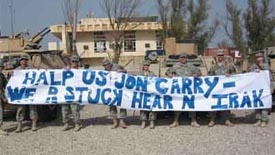
 I usually agree with Mr. Diuguid, but not this time. If anything, we need MORE laughter in our public discourse. Like the soldiers in Iraq who responded to John Kerry’s recent stupid remark with a banner that read, “Halp us, Jon Carry. We R stuck hear in Irak.” Hilarious! Some people were “outraged” by Kerry’s remark – that’s their problem, bunch of fuddy-duddies. Laughing about it is a much healthier response.
Have you ever been in an emergency room and heard the banter among doctors, nurses, and staff? As a hospital chaplain a few years ago, I heard E.R. humor that most sensible Midwestern churchgoers would likely have deemed a smidge … umm … inappropriate, if not downright offensive. But when confronted with the nasty stuff they saw, the E.R. staff had a choice, either make jokes or go insane. Thankfully, they choose to laugh, and subsequently were better able to handle the stress so they could do their jobs.
When one takes oneself too seriously, a whole bunch of bad stuff starts to happen. One’s face gets all frowny and wrinkled, one’s shoulders start to hunch over, the acid produced in one’s stomach starts to eat away one’s stomach lining, and one ends up locked in a padded cell somewhere. Either that or becomes vice president of the United States. It is hard to imagine just how many problems we could fix if we would just agree to lighten up a little bit. Chill out! Relax! Don’t worry, be happy! And all that kind of stuff.
One other thing: I hereby decree that just typing “LOL” on your computer screen doesn’t count unless you actually Laugh Out Loud. Don’t abuse it, people, or else it will be taken away, probably by someone like Lewis Diuguid, who in my humble opinion is not doing anyone a bit of good by telling us to be more serious. As Dr. Seuss says, “From there to here, from here to there, funny things are everywhere!”
I have a specific question on this ordination response: do you think I should use the word "moron?" The word describes my feelings quite precisely, but will it come across too slangy? Any other suggestions would also be appreciated!2. What effect has the practice of ministry had on your understanding of humanity and the need for divine grace?
People are morons.
Okay, that may be a little strong. Let me back off of that a little bit. The practice of ministry has illuminated for me an understanding that without divine grace, humanity would live disconnected, isolated, lives – which frequently causes us to act like morons! This isolation manifests as sin in many ways. The most insidious of these sins are pride, prejudice, and pretension. Without God’s grace, people tend toward a prideful notion of inflated self-importance that is marked by self-centeredness, arrogance, and greed. The flipside of pride is prejudice, which minimizes the worth of another person based on a quick judgment made based on and unfair association of the individual with a group rather than a real relationship of mutual respect and trust. If pride isolates by inflating the self, prejudice isolates by deflating the other.
The third manifestation of isolation is more subtle, and comes in the form of pretensions, by which I mean attitudes and actions that are intended to mask the truth by falsely claiming that circumstances are better or healthier than they really are. What is truly evil about these pretensions is the multi-layered deception involved, in which the human tendency is to pretend that we don’t notice the pretension, even when all people involved are fully aware of them. This phenomenon is what allows us to nod and mumble, “How are you?” to our sisters and brothers sitting around us at worship, even when we do not really want to hear how they are actually doing. Further, it allows the responder to mutter an equally incoherent, “Just fine” without really meaning that, and without any intention of telling the questioner how they really “are.” Pretensions separate people from one another by inhibiting true relationship based on openness and honesty.
The force that acts counter to this isolation is the grace of God, which is a uniting, relationship building power at work everywhere and at all times. And if people will accept God’s grace by connecting to one another and to God, we inevitably find that life is a whole lot easier to live. Practicing ministry has shown me that there will be times that we can help another, and times that we need help; there will be times that we can comfort someone who is grieving, and times when we grieve and need another’s shoulder on which to cry; there will be times when we can serve, and times we need to allow ourselves to be served, and so forth. This is grace. Grace is the ongoing creation of loving relationships centered around the mystery of God, and without it, we are nothing more than a bunch of morons.
Sometime last weekend, Enter the Rainbow was visited by its 30,000th hit. (Since June 25, 2005 when I put on the little counter thing.) I wonder if this will fit into the Conference definition of "fruitfulness" in ministry?
After a month of inactivity, I have begun posting my photographs again over at Reverend Photog. I invite you to check it out.
Here you go, another answer for the Board of Ordained Ministry's questionaire, the answers to which will go a long way toward determining whether or not I am ordained next Spring. This time, from the "Theology and Doctrine" section. Comments are appreciated:1. Understanding of God
a. Theologically describe your current understanding of God.
I feel like the closer I get to understanding who God is, the more I realize there is to know. God’s capacity to be understood is infinite, so my current understanding is a relatively minuscule fragment, a single grain of sand in the vastness of the cosmos. I know God most fully in the incarnation, Christ Jesus of Nazareth. In Jesus’ birth, life, death, and resurrection, I glimpse God at work in the world, and by patterning my life after the example of Jesus, I strive to live as God’s ongoing incarnation even now. As such, I come to understand God by striving to live as God desires, and my striving to live as God desires is informed by who I understand God to be. I ground this dynamic understanding of God in my faith in YHWH, the God whose very name is a verb. In Exodus 3:14, It is written that God self-identifies as “I Am Who I Am” or “I Will Be What I Will Be,” thereby linking faith and action in an inextricable bond. The scriptures record the story of a God who creates, makes covenant, liberates, saves, heals, and most of all, loves. It is by these actions in history that God has been known for generations. And in Christ Jesus, God acted in the most complete way possible; God became human. In the act of incarnation, God became Emmanuel, or “God with us,” and gave the world a life pattern to follow. I have come to know Jesus through study and prayer, and I believe that as I follow the life pattern of Jesus, I come to understand more about God. That understanding then further informs my actions, and the resultant cycle of action and reflection facilitates my continued spiritual growth.
b. How has the practice of ministry affected your experience and understanding of God?
The practice of ministry has given me numerous opportunities to interact with people at many different life moments – birth, death, marriage, sorrow, celebration, and more. These relationships have afforded me glimpses of God at work in a variety of ways – a comforter for the grieving, a liberator for the oppressed, a burst of energy for the lethargic, a savior for the sinner, an uncomfortable agitator for the self-centered, a partner in joy, etc. The sheer volume of God’s capacity for active, vital, incarnate presence in people’s lives that I have witnessed and participated in over the short course of my ministry is indescribable. As a minister of Jesus Christ, it is my privilege to be able to help people name and claim the ways God is active in their lives. And as I have done so, my own knowledge and understanding of God has grown in the process, with the result that I am better equipped to name and claim how God is present in my own life.
 Thanks to the guidance of the revised common lectionary, I have been digging into the book of Job for the last several weeks more deeply than I ever dug before. And you know what? It is a wonderful book!
I think maybe I had always simply bought into the nickel interpretation without really reflecting on anything deeper. You know the whole God-only-knows-why-bad-things-happen-to-good-people-so-just-shut-up-about-it-and-quit-complaining-you-big-whiner interpretation? But dwelling with Job these past four weeks has been like putting my hand to the flinty rock and overturning mountains by the roots to uncover the precious gems of wisdom contained therein. (see 28:9)
Por ejemplo, in chapter 31, Job’s poetic utterances are in the form of “If/then” statements. In a nutshell, he says that if he had done wrong, then he would understand being punished. Surface level interpretation might say that sentiment reflects the theology that says “bad behavior is punished and good behavior is rewarded,” and just stop there. But when you read the “if” statements alone, you get an idea of what the so called “good” behavior is. In other words, reading Job’s “if” statements gives us a glimpse of what God might require of people who want to be blameless and upright, fearing God and turning away from evil (see 1:1, 1:8, 2:3).
Job’s “if” statements from chapter 31 include:
- Lying (v. 5-8)
- Giving in to sexual temptation (v. 9-12)
- Oppressing his slaves (v. 13-15)
- Sins of omission against the poor (v. 19-23)
- Idolatry and greed (v. 24-28)
- Contempt for enemies and strangers (v. 29 – 37)
- Bad stewardship of the earth (v. 38 – 40)
In particular, the sins of omission against the poor are very illuminating. Please indulge in the following:
“If I have withheld anything that the poor desired,
or have caused the eyes of the widow to fail,
or have eaten my morsel alone,
and the orphan has not eaten from it …”
“If I have seen anyone perish for lack of clothing,
or a poor person without covering,…
who was not warmed with the fleece of my sheep.”
In other words, “How does God’s love abide in anyone who has the world’s goods and sees a brother or sister in need and yet refuses help?” (1 John 3:17) I answer = “It doesn’t.” The punishment Job describes for these sins of omission is horrific: “…then let my shoulder blade fall from my shoulder, and let my arm be broken from its socket.” (v. 22) Eww, gross! But perhaps the point is that our arms should be extended to the ones in need around us, and if they are not, they might as well not be there at all.
A close reading of Job, therefore, reveals a text that is profoundly meaningful from a social justice perspective. It is a “social holiness” book that weaves together personal piety and communal responsibility in a way that makes it nearly impossible to think about one without the other. And this is only one of the gems we have mined from the book of Job during our weekly Bible study sessions this past month. Pun intended, I dig Job!
You may already have seen this, but here is an update on the case of the kidnapping of baby Saige Terrell and the death of his social worker Boni Frederick. Saige is safe and in state custody and his mother and her boyfriend have been apprehended.Story here.Commentary here.Video available here.Thank you, God, for the life of Saige. Please continue to hold his mom in your care and give her a sense of your peace. Comfort the family and friends of Boni in their time of grief. And please send your loving spirit to be with social workers everywhere as they continue to do the tough work to which you have called them. Amen.
 I think I may have another axiom for ministry. It might go something like this:
“Everyone is busy – deal with it.”
The reality behind this axiom: In general people live full lives, and young families especially spend much of their time negotiating the complexities, so you can’t be too upset when it seems they don’t have much time/energy left to give to the church. It’s not that people don’t care, or don’t want to, or are lazy slackers or anything. The hours of their day and the days of their week are so full of living life, what they need most is Sabbath rest, not more activities, no matter how holy they might be!
Our Director of Youth uncovered this axiom in trying to plan for a weekend he would be away. He happened to hit a weekend where four or five families had something else going on, and so he was not successful in finding a substitute to lead fellowship time. However, in a marvelous little good news/bad news twist, we only have four or five families involved with our youth ministry right now, so he actually didn’t need a substitute, because everyone is going to be busy! (Don’t you love that?)
People are busy in big churches, too. But the larger numbers of people mean that the overall ministries can absorb their individual busy-ness without feeling it too much. Four or five families might be busy, but there are a dozen more who will be there. In a smaller church like ours, though, having four or five families gone exhausts our youth group, as it would several other ministries here, as well.
However, the axiom is still true: Everyone is busy – Deal with it. We can’t chastise them for not giving of themselves to the church; at the end of their week, there is just not that much left to give. So maybe the church can offer Sabbath instead of more busy-ness. Maybe one way the church can “deal with it” is to allow people to slow down a bit rather than hurling ever more new and exciting activities their direction. Maybe we ought to go deep rather than go broad.
The term “balance” keeps coming to mind. If the church throws too many activities at the people, the balance will tip toward busy-ness. If the church doesn’t have anything going on, we get lethargic. The balance point is somewhere in between the extremes.
Please do not miss this story. A Cabinet for Health and Family Services social worker for the state of Kentucky, bringing a child in state custody for a visit with his mother, was murdered by the mother and her boyfriend, who then took the baby and fled.It happened in Henderson, Kentucky, an economically depressed area where the Red Bird Mission, a United Methodist Ministry, is located. My stomach hurts about this one. As foster parents who work within the family services system here in Missouri, my heart aches for the worker, Boni Frederick, her grieving family and her colleagues, who must be absolutely crushed. And I am praying hard for the safe return of the baby, who is in need of care that cannot be provided by his mom and her boyfriend.There is nothing good to say about this situation. Only questions.What kind of pain does a mom feel that would lead her to murder?What is the baby experiencing, what did he see?How will this affect the way Boni Frederick's co-workers, and social workers everywhere, continue to do their vital and enormously under-appreciated work?God, be with Saige. And his mom. Comfort those who mourn Boni's death. Soothe our troubled hearts, you who hold all of creation in your tender mercy. Amen.