 In the most recent Sojourners there is an excerpt from a book called “A Profound Weakness: Christians and Kitsch.” In it, author Betty Spackman asks some great questions. “Why is it that so much of the imagery used to express Christian faith can be considered ‘kitsch’? Why is such profound meaning visualized in such feeble ways?” Defining kitsch might be a slippery endeavor, but it falls into the area of something trite, cheesy, tawdry, or vulgar. Something created to appeal to an unsophisticated, indiscriminate taste. I consider kitsch to be surface level art; it never gets down to anything profound, substantial, rough. And as far as Christian images in the public milieu, it seems to me that a whole heck of a lot of it is kitsch. “How do I, as a professional artist and a Christian, reconcile (or not) the continuing consumption of things my aesthetic taste and my personal faith reject at so many levels?” writes Spackman. GREAT question! Especially when you consider how much meaning such items seem to have for so many people. There seems to be an enormous volume of material out there that offends both my artistic and my theological sensibilities, and yet seems to hold a deep influence over many, many people. For me, it is not only visual “art,” but also “music.” (Yes, I put quotes around the word music, because a part of me refuses to call what passes for “music” in some churches truly music.) Tinny, two- or three-chord, repetitious, melodically monotonous, repetitious, rhythmically unimaginative, repetitious, and “let’s-just-crank-up-our-amplifiers-so-they-won’t-notice-how-bad-it-is” so-called “music” may very well be the downfall of the worship style formerly known as contemporary. Another category to consider = kitschy Christian email forwards. Why do people insist on foisting such drivel unbidden upon their friends and loved ones? Puppy dogs and rainbows and pink clouds and doe-eyed Jesuses gazing with vapid emptiness off into the sky make me want to hurl. And apparently, if I fail to foist the drivel immediately upon ten of my friends whose email addresses have the bad luck of residing in my address book, God will condemn me to burn in the fires of hell for all eternity. Give me a break! I’m much more concerned with what those ten friends will do to me if I DO foist than with what God will do to me if I don’t.
  Why is it that, for some people, Christianity, a 2,000 year old religion whose roots are grounded in a 5,000 year old religion and whose complexities have been explored by the greatest minds of history for generations upon generations, can be expressed in a snow globe with a figurine of a fair-skinned, blonde-haired, blue-eyed Jesus surrounded by fluffy white clouds? Though I am writing this article with a bit of humor, it really isn’t that funny. The trend in Christian “art” shows a clear degradation of both theological and artistic integrity. This is more than a matter of personal taste. I cannot with good conscience just write this off as a simple issue of preference, wherein a mousepad with a rendering of the poem “Footsteps” and a Cornelis Monsma painting are considered just two options among many in the genre of Christian art. Christian kitsch is theologically shallow stuff, and represents an immaturity of faith that I fear has become alarmingly widespread. I suppose that such material affords us an opportunity to reflect on culture, art, and faith. Betty Spackman writes that objects of Christian kitsch “demand my attention, begging questions about the relationships between consumerism and desire, art and faith, accessibility and elitism.”
  And so there I am, caught between the latest cheesy email in my inbox and my churning stomach. Part of me just wants to laugh at all of this and go on with life, thinking that these things are harmless trinkets that are more indicative of the shallowness of pop culture than anything about Christianity. But another part of me is truly worried that some people really do think the doctrine of incarnation is best expressed with a nativity set comprised of ceramic kitties. And all I can think is, “Yuck!" To see more kitsch click these sites.
I have a post written on the topic of Christian kitsch, but I am having trouble uploading images to blogger.com AGAIN! And if you are going to write a post on Christian kitsch, you have to be able to show some! So I'll keep trying.Anyone else have trouble posting images? And how did you resolve the problem?
Why didn't anyone tell me this news? How long were you all going to let me go on living the lie? I too, like the man in this video clip, am a victim of the force. Go away. I don't want you to see me like this...I just need some time.
Hat tip to my true friend who loves me enough to tell me the truth.
There was some great stuff in the KC Star Faith section today. (Which I cannot actually find at the KC Star website, by the way.)
First, I want to share the text of an advertisement run by First Family Church in Overland Park. They have invited a woman named Shelley Lubben to speak at an upcoming worship service. Mrs. Lubben is a former porn star who has become a Christian and is now sharing her testimony here and there. The ad says, “The 5 truths about pornography … Shelly Luben, having starred in twenty adult movies, was a rising porn star who knows the ugly side of pornography.”
I encourage you to read that quote again before proceeding. Notice anything … odd? Doesn’t reference to the “ugly side” of porn imply the existence of a “non-ugly side?” It is almost as if the church is saying, “Hey, porn is fine and dandy, but you should know - there is an ugly side, too.” This phrase is usually reserved for things that most people think are good, and so the illumination of the “ugly side” helps people see the rest of the story. Pornography is just ugly. There are no “non-ugly” sides of pornography.
(This is not an observation about what Mrs. Lubben is doing, it is an observation about the choice of words of the church’s advertisers.)
Second thing from the Star today was an article about Rev. Gregory Boyd of Woodland Hills Church in the suburbs of St. Paul. The congregation there went from 5,000 people down to 4,000 people when he preached a series of sermons that said, essentially, that the church should not espouse a conservative Republican political agenda. He doesn’t have an American flag in the sanctuary, he doesn’t let people distribute so-called “voter guides” that in reality endorse specific candidates, he doesn’t think we ought to claim the United States is a Christian nation, and so forth. His book is called The Myth of a Christian Nation: How the Quest for Political Power Is Destroying the Church.
What a great case study to consider. Here is a pastor who took a stand for something he had discerned to be right, and it directly resulted in a 20% decrease in his church’s membership. One thousand people walked out when Rev. Boyd said the church should keep its nose out of politics. That’s enough for a-whole-nother church! Can we say that this pastor’s ministry is bearing fruit? Or perhaps the metaphor of “pruning” would be for appropriate here?
Second question: Rev. Boyd holds some pretty conservative opinions, according to the article. Why is it big news when a person holding conservative opinions takes a stand like this, but people holding liberal opinions have been saying exactly this for years and years, and it doesn’t make a ripple? I know that I am generalizing and may be accused of using labels unfairly, especially by Larry B. or Tim Sisk. :) But I’m sticking with the question, anyway. Is this case study in the news simply because it is another example of the backlash to the polarization of America, or is something else going on?
Third question: Is the church being compromised by American nationalism, or is it the other way around (in a sense)? The article today is clearly stating the former; that the Christian message is at risk. But is anyone concerned that the system of government established to be democratic and free from the influence of the church may be at risk, here, too? Boyd hints at it in the article, saying, “America wasn’t founded as a theocracy. America was founded by people trying to escape theocracies.” Shouldn’t the church and the state each be free from the influence of the other?
Lots of questions, and I know that readers will take them in the spirit they are offered – honest questions intended to evoke conversation. This story kind of provides a nice case study to consider some of the questions, and I hope that everyone will feel free to respond respectfully and honestly.
"Oh Lord, you've seen the figures ... "Here is something to laugh about when we are talking about "fruitfulness" in ministry. How close are we as the church to the silliness of this Fry and Laurie clip?Hat tip to John.
I have let the story about Elvira Arellano go by for a while now without comment. She is the woman who invoked sanctuary in a United Methodist Church in Chicago in order to avoid deportation. I haven’t written anything yet mostly because I’m still processing the whole story, and I don’t really have anything new and helpful to contribute to the conversation. But here’s where I am at this point. First, I notice the words we use. Some news sources identify Ms. Arellano as an “activist” and others as an “illegal immigrant,” which are both accurate descriptors, but each shades the story in very differing lights. An activist is likely to be a heroic figure who is taking a principled stand against a large, unjust system. An illegal immigrant is a criminal who is defying the law of the nation. The power of the words we use to talk about one another cannot be minimized. I even read one story that kept referring to her as a “deportee,” which isn’t accurate, but paints a great “innocent victim” picture for the reader.Secondly, I have seen how some news sources highlight the fact that she is a mother doing what she thinks is best for her son. This perspective stirs yet another emotional response, because except for the test tube babies among us, every one of us has a mother. If Ms. Arellano is cast as a strong mother acting on behalf of her child, like a mother hen gathering her chick under her wing, it becomes a bit more difficult to flat out condemn her actions. “I hope my mom would do the same for me,” we think to ourselves.And then thirdly, there’s the role of the church to consider. The idea of a church “sanctuary” as a safe haven for someone who has gotten into trouble with authorities is ancient. Part of the reason many church doors are painted red, in fact, is tied to this notion. There is a wonderful episode of M*A*S*H in which Father Mulcahey takes a stand against the M.P.s who are pursuing a soldier who has gone a.w.o.l. In doing so, he declares the mess tent, where worship service is held each week, a sanctuary and forbids the authorities to enter. I may have missed it somewhere, but I don’t find any official statement in the Book of Discipline about the United Methodist Church’s stance on providing sanctuary – one way or the other. I interpret that to mean that it would be the decision of the local congregation whether or not to take such a step, since it is not forbidden. So I pose the question – “How would I, as pastor of First UMC, North KC respond to a request for sanctuary?” The only answer I can give is, “It depends.”Clearly, Adalberto United Methodist Church has made it a big part of their identity to be in ministry with the immigrant community, so we are talking about two different contexts here. But we have begun a Hispanic Ministry based in our congregation, and held one immigration forum earlier this summer, so we are at least somewhat involved with the issue. So it would not be entirely out of the question for an undocumented immigrant to show up in Northtown some day and say, “Sanctuary.” What would I do?I kinda sorta think that the church should provide sanctuary when it is requested, no matter what. But I most definitely think that what happens next is vitally important. There must be a focused, intentional pastoral response. The only option, really, is to respond pastorally, if I am to be faithful to my call. That may mean standing in the door denying entrance to INS officers, I suppose. But it also means confronting the sanctuary seeker with the perhaps harsh realities of the situation they are in, as well as the situation into which they have put the church by their chosen course of action. It’s not my role to squeal to the cops, but it’s not my role to enable destructive behavior, either.I served as Music Director for a church in Illinois that was a stop on the Underground Railroad. Do you ever wonder what that must have been like? Harboring a fugitive slave, providing sanctuary from the authorities seeking to deport them back to the south, in essence receiving stolen property and keeping it hidden – all illegal activities at the time, and a very interesting parallel to the situation at hand, I think. I imagine that there were some decent, hard working church people who disapproved of such activity, just as there are people in today’s world who disapprove of assisting immigrants in their struggles.Of course, today slavery is almost universally condemned, but at the time it most certainly was not. Harboring a runaway was a crime that carried serious consequences, even for a church. Will there be a time somewhere down the road when the criminialization of immigration is similarly condemned, and churches that provided sanctuary for people avoiding deportation are celebrated as historic sites, the way Underground Railroad sites are in some places?I don’t know Elvira Arellano, and I’m sure I’ll never meet her or anything, but if she really is just a hard working single mom trying to live her life as best as she can while providing opportunity for her son to flourish, all the best to her. I pray that everything gets worked out with justice, kindness, and humility.
John has a fanTAStic poll going on right now over at Locusts and Honey. I encourage you all to participate. Click here.
What would you do if God handed you the theological equivalent of a signed, blank check – totally free, no questions asked, no strings attached, and all that? What would you make it out for? How about good health? Pay to the order of “retirement security”? How about a little assurance of salvation? Or just something mundane, like a million dollars (or the equivalent in stock options)?
Something to think about – if God said to you, “Ask me for anything,” how would you respond? Would you come up with some kind of beauty pageant answer – peace on earth or an end to homelessness or that every little boy and girl in the world would be given a chance to flourish in life thanks to good dental health, or some such thing? Would you try to come up with the most altruistic sounding response possible, so that everyone within earshot (God included) would be duly impressed with your altruism?
It may sound weird, but it’s pretty much what happened to Solomon as recorded in 1st Kings chapter 3, “…and God said, ‘Ask what I should give you.’” Just like that. What do you want, Sol? King Sol could have asked for anything – power, money, respect, military success – anything! But no, not our hero. Solomon says, “Give your servant therefore an understanding mind to govern your people, able to discern between good and evil.”
An “understanding mind” that would be able to figure out what was up, to recognize the best way to go, to determine some sense of meaning in the complexity of life, and to tell the good stuff from the bad – this was what Solomon wanted. And he wanted all this for the sake of other people, so that he would be able to govern effectively – not for his own sake. And so God granted him that wisdom.
Although, if you ask me, Solomon already demonstrated a pretty elevated wisdom score by asking what he asked in the first place. So, was he wise because God gave him what he had asked for, or had God already given him the gift of wisdom, which he displayed in his remarkable prayer? I don’t know for sure, but it seems to me that too often people of faith minimize prayer to a simple wish list, as if prayer was comprised solely of asking God for stuff. I heard a man say recently that we need to ask for God’s help with everything, to realize that we are fully dependent upon God. As an example, he said, “As you spread your peanut butter on your bread, you should be saying, ‘God, help me to spread this peanut butter on this bread.’” My response (which I kept to myself) was to suggest that perhaps God would respond to such a prayer by saying, “Spread it yourself, moron, I have a few other things on my mind right now.” (Although God may choose some other word than “moron” I suppose, maybe “My beloved moron” or something.)
If God were to ask the church today, “What do you want, church?” what would God’s church say? Would the church ask for something on behalf of others, or would it ask for something for itself? I can hear it now, “O God, just make it so we don’t have to close our doors due to the fact that our congregations are dying off and no new people are coming to replace them because what we do here, although good and decent, is lifeless and boring and lethargic and completely lacking in the energy of your Spirit or any kind of new, creative, transformative initiative in ministry for the past forty-five years but if you will just get a couple of young families to come to our church and like the way we do things here then everything will be okay, Amen.” Or something like that.
“An understanding mind” is what Solomon wanted. He wanted to be able to make sense of it all. He was looking for meaning, purpose, vision. It seems God thought that was a pretty good idea, because in response God said, “I give you also what you have not asked, both riches and honor all your life.” And in response to that, Solomon worshipped. Imagine what might happen if a church undertook that process – honest prayer for clarity of vision for the sake of others, wisdom to hear God’s answer and strength to follow God’s way, and grateful worship in response to God’s faithfulness. Sounds pretty wise to me.
...in the car today, listening to "Vertigo," my five-year-old spoke a sentence I honestly never thought I would ever hear spoken.
 "Dad, I believe that U2 may even be better than the Doodlebops."
 It was a special moment.
Over the weekend, Dad and I were keynote speakers for a Missouri Conference United Methodist Men Retreat. Since the retreat was located in southeast Missouri, however, it turned out to be a “St. Louis Area United Methodist Men Retreat” instead. No biggie. There were 70 men there - who were, by and large, a faithful bunch of typical Methodist Men, who joked a lot, sang a lot, ate a lot, and loved God a whole lot.
The average age was just about 60, and the youngest participant was nine. Since we were talking about “Renewing the Church for the Next Generation,” the attendees served as a living example of the issue at hand. The United Methodist Church does not have a “back door problem,” we have a “front door problem,” as Bishop Schnase frequently reminds us. It’s not that people are leaving the church in droves, it’s that they are not coming in in droves. (Anyone know what a drove is, exactly? Where can we get one?)
Anyway, one of the areas where we spent the most time this weekend was around “change.” But what we emphasized what not a change in worship style or technological savvy or the latest 40 day program or any of a whole mess of other gimmicks the church is likely to try. We tried to emphasize that the change called for is deeper and rougher and more profound than that. We are talking about no less than a change in the culture of the church itself, a new mindset when it comes to church, an emerging energy that emphasizes relationship, unity, and authenticity.
We were not talking about adding a guitar and drums and singing the latest Christian pop tune off the radio in worship every week.
We were not talking about throwing a bunch of the latest technology into the sanctuary with no idea about what exactly it will be used for.
We were not talking about buying the latest curriculum designed to appeal to young adults and starting a new Sunday School class with it.
People don’t come to church just to sing the latest song or see a nifty power-point show or read some author’s 12 easy steps to a better life. People come to church to encounter and be grasped by the living presence of God in the midst of a community of friends who share God’s love and grace unconditionally one with another. Last weekend, we were talking about radically reforming the culture of the church so that younger generations will experience that kind of transforming encounter when they come to church.
And furthermore, we talked about ways the church needs to communicate with younger generations to let them know that such an encounter is even possible in a church. There are many who yearn for such an encounter, but for one reason or another, would never set foot inside a church in order to discover it. As such, we talked about new ways of allowing the church to “leave the building” and step into the world, as it has always been called to do. Only now, since the world has changed so much in the last quarter of the twentieth century, the church isn’t sure how to make it happen.
One other thing we tried to emphasize was a shift in thinking from the church being in ministry “to,” “for,” or “with” young adults. Rather, the church needs to be thinking about the ministry of young adults. It is not as if “the church” and “young adults” are two separate groups, one of which (the church) is subject and one (young adults) the object of ministry. Young adults – like youth and children and retirees and everyone else – ARE the church. I think this may be the most difficult mindset to change.
I hope that we tilled some hard packed soil, and maybe even planted a few seeds over the weekend. In terms of renewing the church, I am excited about what is emerging. I sense a spirit of hope in the hearts of many people of faith, hope that is grounded in the mystery of God’s grace. We haven’t yet solved the church’s “front door problem” yet, but I get the idea that we are on the way.
 First - Happy Birthday to my FANTASTIC wife Erin. I love you, darling. I have known this woman for seventeen years, and today she is thirty-five years old. In another year, we will have known one another for half of our lifetimes. And I would not exhange those years for anything.Second - check out this, which is horrifically real. And now this, which is hilariously not. (Hat tip.)Third - A few weeks ago, we did a pretty cool thing in worship where everyone wrote down something they have to offer in service to God and brought it forward to the prayer rail. I posted the responses (anonymously of course) on the congregation's newsletter blog. It is pretty interesting, if you want to check it out.Fourth - Missouri Tigers, Kansas City Chiefs both looking good - it's going to be a good season! I am ready for some FOOTBALL!I'm out for the weekend - see my last post. Not a vacation exactly, but maybe a bit of retreat time. God is good!
Renewing the Church for the Next Generation is the title of a workshop my dad Jim and I are leading as a part of the Missouri Conference United Methodist Men’s Retreat this weekend. As a part of my part of the workshop, I will be discussing two prevalent attitudes I have seen in the church with regard to that most forbidding ecclesial topic: CHANGE.
Attitude number one is called, “We’re Not Changing.” This is the attitude that leads people to say creativity-stifling things like, “Because we have always done it that way” and its corollary, “Because we have never tried it that way before.” Many church people love the way they worship, do Sunday School, church committees, and the like, and they are unwilling to change any of it, or at best cannot see that a change is possible or desirable. Unwillingness to risk a change frequently leads to the lament that goes, “Why aren’t there more young people in our church?” (i.e. “How can we get them to be like us?) This is the wrong question to ask. The only possible way to address this question stagnates a church, because it means trying to figure out how to somehow get young people to enjoy/appreciate/buy in to the status quo, and more often than not, that ain’t happening.
Attitude number two is called, “Change or Die.” According to this perspective, the church must change in order to keep itself from dying off. A catch phrase of this attitude is, “The church is one generation away from extinction.” Many church people expend large amounts of time and energy wringing their hands about the low number of younger people in the pews, and frequently implement haphazard changes in order to remedy that situation. But because those changes are motivated by self-preservation alone, they are not the long-term, comprehensive types of changes that are called for. It can result in a kind of “change for change’s sake” mentality that creates a frenetic atmosphere in which the church’s ministry is disjointed and flimsy, with the church doing whatever it takes to please people so that they will stick around for a while.
The third attitude, the way I will offer as my preferred way, is called, “Change as an Act of Faith.” This way affirms both a desire to be faithful to the calling of disciple-making, and also the desire to change the way things happen in order to more fully communicate with new generations of people. The underlying idea is that, in order to stay faithful to God’s call, we must change. And in the process of changing, we will be reaching new generations for the sake of Christ. We are not changing in order to keep ourselves alive, though. There ought to be no hint of narcissism in the church’s evangelism ministries. The focus is God. We are changing because God has called us to tell the story, and in order to tell the story, we have to translate it in such a way that it can be understood.
So, that’s a smattering of what I’ll be sharing this weekend with the United Methodist Men of the Missouri Conference. I intend it to set the stage for discussion of some more tangible topics. What do you think? Is it a message worth sharing? Would you change anything? All comments welcome …
Yesterday I preached about Nathan, King David’s prophetic advisor. I focused on the lectionary text (2 Samuel 12) in which Nathan encourages David to repent of his quite nasty sin – the whole murder-Uriah-to-marry-Bathsheba incident. Naughty, naughty David!
What strikes me is that Nathan did not come into the king’s room and beat David over the head with the Bible in order to get him to repent. He did not condemn David, nor was he hateful, nor did he come across as self-righteous or smug. Seems to me that Nathan was able to convince David to confess and repent largely because he had a relationship with David. He told David a story, a story that, Nathan explained, applied to David’s own actions. And because of the trust involved in their relationship, because of the respect they developed over time together (2 Samuel 7, 1 Kings 1, 1 Chronicles 17, 1 Chronicles 29), they had an understanding that led David to repent of his sin.
And when he did, Nathan offered words of grace, “Now the Lord has put away your sin; you shall not die.” Oh, there would be consequences to David’s naughtiness; there are always consequences. But the consequence David himself deserved was death. He himself expected it (see verse 5). But Nathan, as God’s prophet, announced that David was forgiven. (The question of why Bathsheba’s child died is a-whole-nother sermon!) God’s grace is not about getting what we deserve, it is about getting what we need.
How many of us can be “Nathans” for another person? How many of us are strong enough in the unity of the spirit and the bond of peace to be able to walk alongside a sister or brother who is deep in sin, nurture our relationship, develop trust, respect, and compassion for them (and they for us), and actually love them enough to be able to give them a gentle nudge back onto the path that God has in mind for them?
It’s like how only your very best friends will let you know that your zipper is down in public. People who don’t care about you will let you go on looking like a fool. Only your truest and best friends will say, “Psst! X.Y.Z., P.D.Q.” (Speaking from personal experience.)
Come to think of it, the only people Jesus really got angry with were the hypocritical church leaders who were telling the people to do things God’s way and follow the law, but were not doing so themselves. He got all fire and brimstoney with people who were guilty of putting their own interests above God’s - Pharisees, Scribes, Money-Changers, and so forth. Other “tax collectors and sinners” were not targets for his Bible thumping tirades, instead he did things like eat supper with them, tell them stories, and protect them from angry, stone-wielding crowds. In other words, he had a relationship with them, and then asked them to, “Go and sin no more.”
There is a difference between being convinced that something is a sin and how we choose to act on that conviction. Some people have chosen a “love the sinner, hate the sin” approach. I have chosen a “love the sinner, period” approach. A loving relationship built on trust and respect makes all the difference.
There is a really cool comment thread going on over at Bill Tammeus’s blog! It started with a post about a Scottish worship service for people who believe in God but do not care for religion. They call them “universal worship experiences,” and describe them this way: “Rather than being based around stories about Jesus Christ, Muhammed or Buddha, the sermons will focus on universal themes such as love, how people can conduct their lives in a peaceful manner, support one another and respect the planet.”
It seems to be an attempt to offer a worship experience to people who are disillusioned, discontinued, or generally disgusted with organized religion. The responses on Bill’s blog are really fascinating, and worth a few minutes of reading. I can best summarize them this way – (and this is not labeling, not over-simplifying, just summarizing!)
- Some say, how can this be authentic, theologically sound worship? It seems to be a bunch of people creating God in their own image and making themselves feel comfortable about what they believe without the rigor scripture or tradition to hold them accountable.
- Some say, this is a good thing for people with faith in God, but no faith in how God has been codified by humanity. This experience frees people to worship the God who is, who was, and who ever shall be, instead of the God that a specific group of people describes and defines according to their own cultural lens.
- Still others say, I have found a spiritual home, and am quite happy with my religion, my relationship with God, my particular path. However, my path to God may not be yours, and so an experience like this, while it wouldn’t work so well for me, may create for someone else an opportunity to encounter God, and so it should be encouraged.
- Finally, there is probably a group who is reacting by shrugging their shoulders and saying, I don’t really know enough about this endeavor to make a judgment yet.
I think I am mostly in the third group there. I am Christian - incarnation, crucifixion, resurrection, and all that kind of stuff. But I am also pretty firmly committed to the idea that being a stumbling block for another person’s relationship with God is not a good idea. In fact, scripture records some pretty harsh words, uttered by none other than my Lord and Savior Jesus Christ and echoed other places, about those who are stumbling blocks to others. (Something about a millstone around your neck, if I remember correctly.)
I lament that I may be a stumbling block getting in the way of someone’s relationship with God just because I am a Christian, but there it is. Right or wrong, the perception is out there. I saw a "Family Guy" episode recently where Brian said, “Let’s see, ‘Believe like I do or else I’ll hurt you.’ Yep, sounds like a church!” I have spoken with numerous people who have said, “I’d like to come to church, but I don’t feel like I will be accepted there.” A friend recently emailed me, “Considering the hatefulness and exclusivism and intolerance I hear every week in church, I sometimes wonder if I’m wasting my time being a Christian.” It was not the first time I had heard such a sentiment.
I want, with all of my heart, for all people to be in right relationship with God, and I believe that God wants that, too. If my stubborn insistence that they do things my way is a stumbling block causing them to sin, that is, keeping them from living in right relationship with God, then I must give up that stubborn insistence and seek another way to set the stage so that God might enter the scene.
Maybe an interfaith, low pressure, relevant and meaningful worship service will be how God enters the hearts of people for whom walking through the doors of a church, temple, synagogue, or mosque building would be unthinkable. (As a friend wrote recently, “Feels like a lion being thrown to the Christians.”) I believe God is powerful enough to work in the midst of anything, and will find a way to work in the midst of a “Universal Worship Service,” too. Maybe they are creating God in their own image, but maybe God can find a way to work with that. If they are unreceptive to encountering God in a traditional religion anyway, trying something a little theologically “iffy” couldn’t hurt, could it?
Here’s what I’m talking about. Today in our Kansas City paper, a prominent mega-church pastor wrote a little column answering the question, “How far should Christian tolerance of other faiths go?” Of course, he was set up, really. Using the red-flag-raising word “tolerance” isn’t really fair, since the word begs definition and clarifying before anyone can talk about it. Plus they only have him a few inches of newspaper space to answer, and I’m sure that if had been given sufficient room, he would have said more.
Nonetheless:
He first makes a helpful if unnecessary distinction between “tolerance” and “love” – meaning that while we love everyone, we don’t necessarily need to tolerate them. With this distinction, we can already see where he is headed. He writes, “We know that the God’s Word is true [sic]. The Gospel of Jesus Christ is the bedrock of the Christian faith. Anything more, anything less, any alternative religious system cannot also be true.”
(Wait, “anything more?” Huh?)
He goes on to say that although we Christians love everyone, “it is not our place” to “choose which things are true or false.” And that (here it comes … are you ready?) since “Jesus himself” says he is the truth (quoting John 14:6), “who are we to say differently?”
Here is a strictly hypothetical conversation:
Me: You are a Christian, huh?
Mega-Church Pastor: Yes, sir!
Me: Hey, me too! That’s great. So that means you believe Jesus is the truth, right?
MCP: Yes, absolutely.
Me: Hey that’s cool. Can I ask how you know that?
MCP: Because he says he is.
Me: (awkward pause to consider the logical flow of the conversation) But how do you KNOW that what he is saying is true?
MCP: Because he is the truth.
Me: And … let’s see…how do you know he’s the truth? Oh yeah, you know that because he says he is, right?
MCP: That’s what I wrote in my column, and I’m sticking to it!
My point is not so much that this one pastor might have said more about Jesus-as-truth had he been given sufficient time and space to do so. (Not to mention what exactly he meant by “anything more” than the Gospel – like, God?) My point is that people read this column and think, “What in the world? Why would I ever want to be a part of something so irrelevant to my life? I am seeking purpose, meaning, I want something to live for, I want something that will make sense! I had better look somewhere other than the church to find that, I guess.” And thus there is all the more work to do for people of faith who want to share the Gospel of Christ with our neighbors in a way that doesn’t resort to self-referential jargon to accomplish that mission.
In the meantime, I found this while preparing tomorrow’s sermon:
“I pray that you may have the power to comprehend, with all the saints, what is the breadth and length and height and depth, and to know the love of Christ that surpasses knowledge, so that you may be filled with all the fullness of God.” (Ephesians 3:18-19, emphasis added)
There we go! Maybe Christian epistemology is a worthless endeavor after all, Tim Sisk! That which we are seeking to know surpasses knowledge itself. Reminds me of something Brian McClaren wrote, “One doesn’t learn what God is like in a library or pew and then begin to love God in real life. One begins to love God and others in real life. In the process one learns what God is like – and one might be driven to the library and pew to learn more. Anyone who doesn’t embark on the adventure of love doesn’t know God at all, whatever he can say or define or delineate, for God is love” (Generous Orthodoxy, 207). I marked that one in my margin!Or something Linus said to Charlie Brown once, "To know me is to love me!" But maybe when God says it it is, "To love me is to know me."Hmm ...
Hey! Great news! We are now providing care for two wonderful children as their foster parents for a while. And so far, so good.And there is kind of a fun story that goes along with this news, a story that starts long before we knew we would be having two foster kids...It seemed like a good idea at the time. "Sure," we said to my parents, "We'll watch your dog for you while you go on vacation." After all, she is a big, old, slow dog who doesn't do much but lie around the house all day. No sweat.So then, when my brother called, asking if we would watch his dog for the weekend, the same weekend we were watching my parents dog, we thought we could handle it. His dog is a ... hmm ... how to put this delicately? ... smidge more hyperactive, shall we say. But for just a weekend, we can do that. "Sure, B. Bring her on over."Then he calls back, "Umm ... do you think you guys maybe could watch her for three or four more days? Our plans have changed." With a bit of hesitation, we say, "Uh, okay." Now, you have to understand that when I say the dog is a smidge more hyperactive than most dogs, I mean she is absolutely insane. So we were to have four dogs in the house, our two plus the two we were watching. One of our dogs is in the old-and-not-very-active category, and one is a-smidge-more-hyperactive. Not absolutely insane like my brother's dog, but up there. But we would be fine - a little crazy, but fine.So that, of course, is when we got a call from a case worker, wondering if we might have two foster kids come to live with us. It was the call for which we have been waiting these past four months, so of course we said "YES!" And we had the pre-placement visit which went very well, so two days later, here they are! And they are absolutely wonderful. They have seen and experienced way too much in their short lives, and we are all taking our time about getting to know one another, learning to trust each other, and basically figuring each other out.Thus we are currently housing two grown-ups, four children, and four dogs, two of whom are a smidge hyperactive. Of course, this is also the week my grandparents are moving from North Carolina to Dallas, and a bunch of stuff from their house will be coming to our house in Kansas City next Monday, some to stay and some for temporary storage. Plus I caught a nasty summer cold that kept me home Wednesday, we have four church people in the hospital I need to keep tabs on, and a funeral set for next Monday morning. Other than that, not much going on!It's all good! We are still smiling, at least at the moment. But the last week of July, 2006, will go down in Bryan family history as quite a remarkable week, to be sure.
Bill Tammeus writes good stuff – about faith, the church, ministry, and life in general. This week, he wrote about pastoral care. Using a touching story about a young man who received care from a non-clergy caregiver, Bill wrote that some of the most meaningful pastoral care a person can receive come from laity, rather than clergy.
He goes on to say that many congregations are simply not set-up to equip the laity to do pastoral care. Why not? He gives three reasons.
Reason 1:
“Sometimes it’s because people act like they belong to a club with a hired manager (the clergy) instead of to a church that requires ministry of some kind from all members.”
I know congregations like this, don’t you?
Reason 2:
“Sometimes it’s because clergy are insecure and feel threatened when competent laypeople express an interest in living out their faith by offering pastoral care to others.”
I know clergy like this, don’t you?
Reason 3:
“But mostly congregations fail in this area simply because their members are so busy just surviving, just doing all that must be done to work, rear children, pay the mortgage and nurture family relationships that they think they have no time to spend” doing pastoral care.
I know … just about everybody fits in here … don’t you?
I have developed a kind of pastoral care triage by which I work, in order to keep things all in balance, or, at least as balanced as possible. I have to start out with the confession that I will not be able to visit every person who needs a visit. That is hard for me to say, because I am a type “A,” first born perfectionist with a pretty advanced case of “People Pleaser-itis.” It is hard for me to acknowledge that I am unable to be all things for all people. But the truth is, I simply cannot provide pastoral care for everyone who needs it.
But I try very hard to provide pastoral care to everyone who asks for it. Triage level one is people in the hospital and their loved ones, family and friends of people who have just died, and people who come to me with immediate crises, situations in their lives that are urgent, spiritual or emotional needs that they need to talk about. Providing pastoral care at this level takes up a lot of time. In fact, it takes up just about all of my week that isn’t allotted to something else like worship planning, sermon writing, study preparation, correspondence, and the like.
That leaves out triage level two which is comprised of people who, for physical, spiritual, or emotional health reasons we need to sort of “keep in touch with” more intentionally. They are not in immediate crisis mode, but are still very fragile, very vulnerable. This group is ministered to by our able and dedicated group of Stephen Ministers. I cannot commend this program highly enough for a church wanting to expand its care-giving ministries. The Stephen Ministers in our congregation are compassionate, well-trained, and have a clear understanding of their role in the life of the church. I am so grateful for them.
There is another level, though. This group is comprised of people who are not in immediate crisis, and who are not in an especially vulnerable place, but who just may not be able to get out of their house, or may live in a nursing home or care facility. Some refer to these people as “shut-ins” or “homebound” persons. I visit such persons only rarely. I wish I could more often, but the reality is that I cannot. Fortunately, we have a gifted and compassionate man who has answered God’s call to coordinate (as a volunteer staff member) the visiting ministries of our congregation, and his focus is on people in this category. One of his ongoing challenges is to equip and train more visiting ministers to stay connected with God through their church.
I guess I am lucky to be serving in a congregation who doesn’t think that I am the hired manager of their club. Also, I try to encourage and equip parishioners to offer pastoral care in various ways without any fear or insecurity that they will be somehow usurping my role. My prayer is that we will all not end up being “so busy surviving” that we end up unable to care for one another as we should. A church whose members care for one another is a healthy church. And a pastor who is fortunate enough to be a part of such a congregation is a healthy pastor, as well!
 Let us stand and sing our opening hymn:
Here comes the King, here comes the big number one!He's Jesus Christ, the King, he's second to none!The King is coming, to save us all!When you say Christ, you've said it all!Hat tip. Link.
One of my friends has started a blog called STILL: Life. Every day he posts a photograph that in some way, shape, or form documents his day. But he has given himself a rule - there can be no people in his pictures. It has been really fascinating to visit STILL: Life every day and see his pictures and read the titles to his posts. Go on over and check it out.
Last week a long lost friend found me by googling my name. It has been really great to reconnect with her. One of the things she found on google, which I had almost forgotten about, was a news story that UMTV did about my family. You can watch in from the umtv.org archives by clicking here. Keep in mind that it was three years ago, and my hair is much better now!
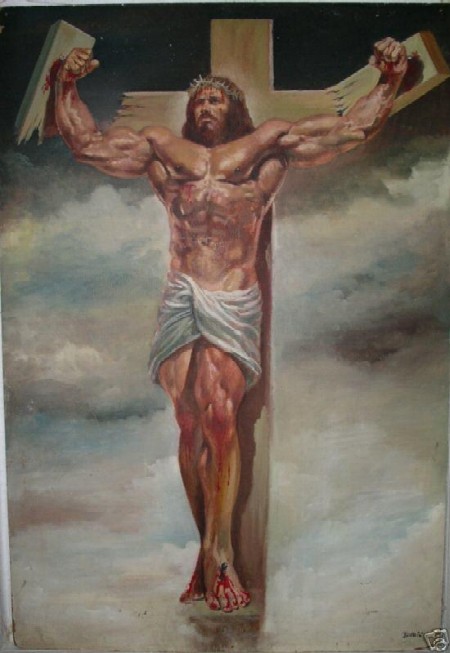 In the most recent Sojourners there is an excerpt from a book called “A Profound Weakness: Christians and Kitsch.” In it, author Betty Spackman asks some great questions. “Why is it that so much of the imagery used to express Christian faith can be considered ‘kitsch’? Why is such profound meaning visualized in such feeble ways?”
  Why is it that, for some people, Christianity, a 2,000 year old religion whose roots are grounded in a 5,000 year old religion and whose complexities have been explored by the greatest minds of history for generations upon generations, can be expressed in a snow globe with a figurine of a fair-skinned, blonde-haired, blue-eyed Jesus surrounded by fluffy white clouds?
  And so there I am, caught between the latest cheesy email in my inbox and my churning stomach. Part of me just wants to laugh at all of this and go on with life, thinking that these things are harmless trinkets that are more indicative of the shallowness of pop culture than anything about Christianity. But another part of me is truly worried that some people really do think the doctrine of incarnation is best expressed with a nativity set comprised of ceramic kitties. And all I can think is, “Yuck!"