Tuesday, February 13, 2007

Hitting Your Spiritual Snooze Button? - Transfiguration Thoughts

What do you do with the Transfiguration story? That’s this week’s lectionary reading, Luke’s version. I get the feeling the Transfiguration story must be important, but I’m not really sure why. Kind of like District Superintendents. :) (Joke.)

Luke has a line in the story that has caught my eye this time. Luke 9:32 says, “Now Peter and his companions were weighed down with sleep; but since they had stayed awake, they saw his glory and the two men who stood with him.” (NRSV) It reminds me of another time the disciples got sleepy, in the Garden of Gethsemane on the night Jesus was arrested. Only that time, they went right ahead and fell asleep.

“Since they had stayed awake, they saw his glory.” Maybe the whole thing was a result of sleep deprivation? You know how when you stay awake really late at night and you start getting all loopy? Maybe Peter, James, and John were just really, really sleepy and their minds were playing tricks on them.

Or maybe it’s more about “staying awake” spiritually, so that you don’t miss an opportunity to see Christ. Maybe sin is essentially evidence that we are spiritually asleep, not aware of Christ’s presence, unable to recognize the glory of God revealed in Jesus Christ. And the thing about being asleep is that sometimes your dreams are so vivid, you don’t realize you are sleeping. That is, until you wake up.

This metaphor is helpful for me in thinking about many sins. Sin is a vivid dream in which your perceptions seem real and good and right and just, but they are only a dream. Upon waking up and seeing Christ’s glory, you realize that your sinful life is just a dream, and salvation is an ongoing attempt to stay awake spiritually so that you will live a life that God intends. The devil LOVES this situation, you know? With this sleeping/dreaming arrangement Satan has worked it out so that we are sinning, but we don’t realize we are. Not only do we not realize it, but we actually think we are being righteous, so we just keep on sinning/dreaming, all the time unaware of our sin.

Consider affluence. How many of us try to live in the dream that says it is okay for some people to have a big house, two cars, closets full of clothes, pantries full of food, while other people lie on heating ducts downtown with all of their worldly possessions stuffed into a dirty backpack beside them? I know I do. Any excuse I try to offer is the equivalent of pressing my spiritual snooze button. “Just ten more minutes, okay Jesus?”

There’s something here also that reminds me of one of the themes from “The Matrix.” Neo was awakened to the ugly, painful reality of the world, having been in an altered state of perception in which his life seemed to be quite ordinary and relatively easy. The most insidious sin is not a horrific, blatant act, but rather the attitude of indifference displayed by all of us who are asleep to the reality of the world.

Peter, James, and John stayed awake, despite their sleepiness. That is vital to our salvation, to be awake and alert for opportunities to glimpse the glory of God. How easy it is to drift off into quiet, comfortable, blissful slumber and dream the “everything’s okay” dream. But the call of Christ is to remain alert, stay awake, get your hand away from that snooze button! Wake up and see the glory of Christ.

Tuesday, February 06, 2007

Gambling vs. Investing

My wife Erin told me about an interesting discussion in her Sunday School class last week. Part of the conversation centered around this question:

What is the difference between gambling, which the UMC is against, and investing, which the UMC is definitely in favor of?

What do you think? All comments appreciated:

Ex Nihilo Discussion, Ages 6 and 9, A True Story

6 year old: What was there before there was anything? There couldn't have been just blackness, because black is something. But it couldn't have just been all white, either, because white is something, too. So what was there before there was anything else?

9 year old: Well, there never was a time before there was anything else, because no matter what, God has always been there.

6 year old: Hmm.

Yes, our 6 year old is a philosopher, and our 9 year old is a mystic.

Monday, February 05, 2007

Super Bowl 41: "The Lord's Way"


Did anyone else find the Super Bowl yesterday to be a bit … weird? The teams played mediocre at best. The camera lenses kept getting fogged up. The commercials were horrible. Prince didn’t dance. It was like a Super Bowl Twilight Zone episode.

And then there was the trophy presentation. Here’s what Tony Dungy said:

“I’m proud to be representing African-American coaches, to be the first African-American to win this. That means an awful lot to our country. But again, more than anything, I’ve said it before, Lovie Smith and I, not only the first two African-Americans, but Christian coaches, showing that you can win doing it the Lord’s way, we’re more proud of that.”

At first, that’s a nice thing: a kind of color-blindness that seems to befit the Gospel, and a simple example of a Christian man witnessing to his faith. But if you listen to his remark a few times, it just raises more and more questions than anything else. Here are some of mine:

1 - So, winning the Lord's way involves spotting the other team a touchdown on the opening kickoff, having the opposing quarterback to fumble all over the field, missing an extra point and a chip-shot field goal, having the opponents best running back get injured, and then running the most boring, conservative, dink-and-dunk offensive gameplan ever written? Give me a good Red Sea parting any day. Come on, even God was bored.
2 - He’s talking about football, right? So, is he claiming that the Lord actually cares one way or the other about who wins a particular football game? As if Jesus needs to be validated by the outcome of a sporting event. I am as big a fan of the game as anyone, but I’m not quite ready to say that God is quite that interested, and may have even had a few other things on the heavenly agenda for that day.

3 - This latest Super Bowl was the 41st one. If Dungy is right, why has it taken 40 years to “win doing it the Lord’s way?” Was it a modern day journey through the wilderness of other ways to win the Super Bowl, awaiting Moses Dungy to lead the NFL into the promised land of the Lord’s Way to Win?

4 - On the flipside of question 2, I wonder what all the other 40 winners of the previous Super Bowls think about Dungy’s claim that now, at last, he and Lovie have shown you can win it “the Lord’s way?” Let’s check in with Bill Walsh on that one. Somebody go ask Tom Landry what way he was winning, since it must not have been “the Lord’s way.” Vince Lombardi, care to comment?

5 – And on the flip-flipside of that, wasn’t Lovie Smith doing things “the Lord’s way” last Sunday? If Dungy and Smith are examples of coaches coaching “the Lord’s way,” why did God pick Dungy to win this one and not Smith? Did Dungy just pray a little bit harder that morning or what? Lots of grey area there. Gets to the whole theodicy question (our favorite seminary word!).

OK, OK - I know that Tony Dungy wasn’t trying to be all deep and theological when he was accepting the Lombardi Trophy last Sunday. He really seems like a nice guy, and I’m not trying to beat him up or anything. But his expression “showing that you can win doing it the Lord’s way” kind of makes my stomach gurgle a little bit. Not because of what it says on the surface level, but for the questions it raises underneath. I just think we need to be extra careful whenever we are claiming that God has favored us in a particular way. Often such a claim carries with it implications that we likely do not intend.
God loves us and all, but I'm pretty sure that by halftime, God had switched channels, and was watching Puppy Bowl III on Animal Planet.

Tuesday, January 30, 2007

Important Message to All Methobloggers:

Please, whatever you do, nobody tell John about this.
I don't want to be responsible for getting him riled up.

Monday, January 29, 2007

Cursillo Weekend - Prayer-O-Rama

This past weekend at the Cursillo my wife and I helped with, I prayed more often and longer than I have in my life. That was kind of the point of what I was responsible for, to pray for people. But I have never prayed with such intentionality and specificity for such an extended period of time.

And kneeling, no less! I tried a variety of postures: I knelt with my back straight and my hands held out, I knelt down low and almost "hunkered over," I knelt on one knee, I leaned on the altar with my elbows - any posture you can kneel in, I tried! Different postures leant themselves to different prayers, I found. Depending on where I was spiritually, I think different postures just somehow "worked" better.

It was an amazing weekend, again. Four people from our church attended, and four were there to work. Everyone had a powerful experience in the presence of a community of grace and love and unconditional care and compassion. My wife and I were each moved, renewed, and exhausted! We return to the world with the assurance that God is good and the undeserved grace of Christ is sufficient and the Holy Spirit is alive and calls us all to serve one another with love and joy.

Friday, January 19, 2007

Don't Be Church People: Thoughts on Luke 4

Luke 4:14-30: The Synagogue People

The synagogue people thought all along that Messiah was coming to them, and for them. And furthermore, they had heard the scuttlebutt that this Jesus bar Joseph may just be the One. Imagine their surprise, then, when they hear the list Jesus reads them (v. 18). It is a list that describes the people Jesus has been anointed to serve:
- the poor,
- the captives,
- the blind,
- the oppressed.
And, via his reference to the Hebrew scriptures (vv. 25-27):
- the foreigners,
- the widows,
- the lepers.

“Hey,” said the synagogue people, “We don’t hear ‘synagogue people’ on your list, Jesus.”
JC replied, “That’s right.”
“But what do you know, carpenter boy?” they fired back, thinking, “He must not be Messiah, after all. How could he be, since WE didn’t make the list?”
In fact, the absence of the synagogue people from the list made them so mad that they decided to throw Jesus right over the cliff, out of their lives forever.
***
How many times do we, realizing that Jesus is here for more than just “us,” try to throw him over the cliff and out of our lives forever?
- By the way, “US” = people who look like me, act like me, think like me, share my morals, speak my language, believe what I believe, are in my age group, have my same sexual orientation, earn an amount of money similar to mine, are of similar skin color, and so forth.

Of course, the synagogue people in Luke 4 threw Jesus only out of their own lives; they did not deter his mission. Up at the top of that cliff, Jesus walked right through the midst of them and went on his way (v. 30). And, presumably, the synagogue people went right on being synagogue people, and missed the whole thing.

Let’s not be “church people,” thinking that Jesus is somehow “ours,” came to “us,” is here for “us,” saves “us” from “our” sins – all of which presumes a “them” and a “they” for whom Jesus did not come: the “not-church people.” Remember the list: poor, captives, blind, oppressed, foreigners, widows, lepers. The ones whom the world forgets, Jesus remembers. Our inability to grasp the scope of the Messiah’s mission will not deter it, but it may mean that we miss the whole thing.

Sunday, January 14, 2007

Missouri Ministers' School 2007

Whew! Residents in Ministry and then Missouri Ministers' School last week just about wiped me out. The RIM meeting was Monday and Tuesday, then Ministers' School was Tuesday through Thursday, back to back. The RIM planners several years ago reasoned that tacking the RIM meeting onto the beginning of Ministers' School would save people a trip. In truth, it just makes the week really, really long and forces many residents to choose one meeting or the other, and since the RIM meeting is requried for ordination, guess which one they choose.

Tidbits from last week:
- We had a breakout session about blogging as a spiritual discipline as a part of the RIM meeting. About twenty of us sat in a circle and talked about blogs, why people have them, how to set them up, and their potential as not only a personal spiritual discipline but also a powerful ministry tool to facilitate communication and evangelism. It was good to be able to speak as the "resident expert," so to speak.

- It is extremely hard, if not impossible, to be present at one meeting while trying to prepare for another. I am the chair of the Board of Managers for Ministers' School, and so I was trying to make sure everything was set and ready for that big event, but at the same time I was trying to be at the RIM meeting. Not recommended.

- Ministers' School went quite well, with no major glitches. We have a fantastic board of managers this year, who all did their jobs very well, thus making my job all that much easier. The faculty this year was Bishop Robert Schnase, Dr. Hal Knight, and Rev. Emanuel Cleaver III. They were focusing on the theme "Stay Focused on Jesus: the Reward is Worth the Effort." The theme and faculty were put together by the dean, who this year was Rev. Dorothy Smith. Around 250 clergy from all over the state attended.
*I will be the dean in 2009 and 2010 - I'm pretty excited for that!

- During Ministers' School this year, I did something I have never done before. From my spot at the piano, I "bumped the preacher" at the end of his sermon! It was great! I had attended worship services where the organist or pianist started playing along with the preacher as the sermon reached its climax, and always wondered if they worked it out ahead of time or just kind of let it happen. Tuesday night, I was listening to Rev. Cleaver (EC3) preach, and thought to myself, "This sermon is pretty good. It is just the kind of sermon that ought to have a little musical umph." And before I knew what was happening, I was doing it. And when I talked with Emanuel afterwards, he said that it was good, so I was happy.
If you haven't experienced it, "bumping" is comprised of extemporaneous, improvised phrases on the keyboard, in time and pattern with the preacher's sermon. These phrases should be in a blues/gospel style, and ideally will accentuate the rhythm of what the preacher is saying, enhancing the experience for the congregation. Most of the time, it happens in a black church, but my very caucasian hands just seemed to take on a life of their own and the back-and-forth between Emanuel and me really felt like the Spirit was moving. It was pretty cool.

- I have started the spiritual discipline of Examen - at the end of every day I pause and look back over the day, asking myself when I experienced the presence of Christ most fully, when I felt furthest away from God, when I was able to love as God loves, when did I fail to do so, and so forth. This discipline is a part of my Residency covenant.

Okay, there's more from last week, but I'll just stop there. Any more at this point would just be boring. Onward ...

Thursday, January 04, 2007

On the Way to Ordination

Next week is going to be a biggie. Monday and Tuesday will be my final Residents in Ministry meeting before ordination, and Tuesday through Thursday will be Missouri Ministers’ School, of which I am the chair of the Board of Managers. Both events, which technically do not overlap but practically do, are at Tan-Tar-a Resort in Osage Beach, Missouri. By the time I get home Thursday evening, I expect I’ll be pretty wiped out.

What a ride this trip toward ordination has been, and continues to be! If I am ordained this June, it will have been almost eight years since I responded to God’s call and made the decision to seek ordination. That’s a lifetime. EIGHT YEARS! And now just a few short months (and one high-pressure round of interviews) to go.

To kneel before God, surrounded by the conference, uplifted by my family, fortified by the six generations of ordained Methodist clergy before me, to feel the Bishop’s hands on my head, to bend and receive a stole around my neck for the first time in over a year, to know the church’s affirmation of the way the Holy Spirit is at work in my life – I cannot now imagine what that’s all going to feel like. But I’ll bet you it will be pretty cool.

I may even write a blog post about it. ;)

Friday, December 29, 2006

Called, Part 2

Back before Christmas, I wrote a post about my sense of calling. It generated a lot of buzz, from church members and bloggers alike. Some people really seemed to “get it,” some were concerned for my mental health, and some were quick to … shall we say … “encourage” me to just get over it and do my job.

At the time of my writing it, I was in over my head in terms of trying to get done simply what needed to get done, and I had momentarily lost contact with the foundational sense of my calling to ministry. I asked several dear friends to again remind me of why it was exactly I was doing this pastor thing, and they did, and I’m okay now. Experiencing Christmas helped, too.

I just have one more thought to add. In the comments of that post, a couple of people mentioned “survival.” Adam wrote: “But I guess unless I want to move out to the forest, or really push the envelope of living in our society, i'll have to do what i'm not called to do to survive!” And Codepoke wrote: “The modern pastor's job is almost unsurvivable.” That got me to thinking a bit.

Seems to me that there must be a distinction between living out your calling and doing what is necessary to survive. See, I don’t want to “survive” as a pastor, I want to strive to realize my full potential, to flourish, to thrive. I guess survival mode means doing all the stuff because you have to do it, period. There’s nothing underneath in which to ground it, only survival itself. And that’s where I was a couple of weeks ago - just doing the bare minimum. It didn’t feel good, and it showed in my writing.

I know, I know – “Boo-hoo, Andy. Get over it!” Listen, I know people who have been forced into true survival mode by the vicissitudes of life, and it absolutely consumes them. I am not remotely trying to do any comparison thing, here.

So here’s where I am now. Having come through that little down-time a bit, I am in touch again with my calling to ministry, which means that I’m still doing all the stuff I ever did, but now there is some fertile soil in which it can take root, be grounded. It’s not that I’ll have to do what I’m not called to do just to survive. It’s more like my calling will undergird everything I do as a pastor. Even balance budgets and read forwarded emails!

God is good!

I Think It Says a Lot!


Here's my idea for a new personality inventory:
Were you more affected by the death of Gerald Ford or James Brown, and why?

Sunday, December 24, 2006

Braeden James Bryan


Born December 24th, 2006
12:39 p.m.
8 lbs. 3 oz.
19 inches long

Everybody's doing great!

My sister Stephanie (Mom), my brother Brad (coach), my mom Caryl (grandma), my daughter Cori (cousin), and I all had a chance to hold him. He is ADORABLE!


Friday, December 22, 2006

Adam Mustoe's Christmas Reflection

Adam Mustoe has posted an incredible Christmas reflection that is definitely worth your time. Click here.

Tuesday, December 19, 2006

Called

I am not called to balance budgets.

I am not called to track contribution patterns.

I am not called to count heads in worship services.

I am not called to produce slick advertisements to hang on doorknobs.

I am not called to decide what kind of tile to put on the Fellowship Hall floor.

I am not called to cater to the nostalgic whims of the way things used to be.

I am not called to perpetuate the institutional status quo for no good reason.

I am not called to stroke the egos of pathological complainers.

I am not called to sit on committees that do nothing.

I am not called to read email forwards.

I am not called to reboot servers.

I am not called to fill out forms.


I am a pastor.

I am called to offer Christ to people.

I am called to proclaim the Gospel so that the reign of God will be realized on earth as it is in heaven.

I am called to serve people who are striving to pattern our lives after the example of Christ.

I am a pastor, and I am called.

Friday, December 15, 2006

Biblical Definition of Marriage?

I read it again today in the paper - the phrase "Biblical definition of marriage." This time, it was New Jersey Assemblyman Ronald Dancer, who said, "It's my personal belief, faith and religious practice that marriage has been defined in the Bible."

As many times as I have heard people say this, I have actually never heard anyone cite book, chapter, and verse in support. So that I might be better able to engage in conversation about this issue, will someone please give the the scripture citations to which people are referring when they say "Biblical definition of marriage"?

I'd be most appreciative.

Monday, December 11, 2006

Stranger Than Fiction - My Thoughts on the Movie

My wife and I saw “Stranger Than Fiction” over the weekend. We recommend it – great writing, sharp acting, and a storyline that really drew us in right from the start.

SPOILER ALERT - STOP READING THIS IF YOU HAVEN’T SEEN IT YET AND DON’T WANT TO KNOW ANYTHING ABOUT IT.


I found this movie to be deeply Christological. Here’s my take. Harold Crick (Will Farrell) is the Christ figure, the one whose life begins to be narrated by an unseen voice, who represents the Holy Spirit. The voice encourages Harold to pursue his dreams, to begin living his life, an allusion to the incarnation. Harold is brought to life by the narrator, who is in fact an author writing a novel (Emma Thompson), as Jesus Christ is “brought to life” by the Holy Spirit. This author has an assistant who helps her write the story, and who I couldn’t help but think of as an angel. (I’m sure that had nothing whatsoever to do with the fact that the part was being played by Queen Latifah.)

Harold falls in love with a baker named Ana Pascal (Maggie Gyllenhaal) in the process of auditing her bakery. (Harold’s real life job is as an IRA auditor.) I find it charming that, as he was digging into her life in order to find out what she had done wrong, his motivation was to prevent her from being punished. He said to her several times, “I just want to keep you out of jail.” Isn’t it also true that Jesus digs up our lives, bringing to the surface the things we do, in order to prevent us from being punished for our sins? "Miss Pascal" is at times a kind of Mary Magdalene/disciple figure in the story, and she is won over by Harold’s demonstrations of love, including a gift of “flours” and a heartfelt song. Of course, Ana also plays an active role in Harold’s decision to fully live his life, which happens as she offers him freshly baked cookies. It may be a glimpse of Jesus’ relationship with Mary, Martha, and Lazarus, which is one of the most "fully human" moments of Jesus life.

In his incarnation, Harold seeks guidance from a professor (Dustin Hoffman), the all-knowing presence who ends up telling him that, in order to finish the story, he must die. Connected by the phrase “little did he know,” Harold comes to the professor again and again, as Jesus did in prayer to God the Creator. And there is even a “Gethsemane,” the scene at the swimming pool where Harold comes to the professor, who is working as a lifeguard, to ask if there is any other way that this might happen, or “if this cup might pass him by.” The professor replies that this story is the masterpiece of the author, and that there is no other way to finish the story except by dying, just as the story of salvation would not be complete without Jesus’ death. Harold then visits the author, telling her to go ahead and finish the novel, he accepts that it is the only way. “Not my will, but yours be done.”

The “crucifixion” scene is poignant, as the narrator is typing the ending to the story, tears streaming down her face with grief, and Harold walks to his bus stop. As she narrates the unavoidable conclusion, a boy (representing humanity?) falls off of his bike in front of the oncoming bus, Harold dashes into the street and pulls the boy out of the way, and is crushed in the way only the full impact of a city bus can crush a person. Harold dies to save the boy, as Jesus dies to save humanity. At that point, the audience is fully convinced that Harold is dead, and the story has reached its final, climactic moment.

But then the author visits the professor, carrying with her the final manuscript copy of her novel. Handing him the envelope, she says, “I think you will be happy with the new ending.” Harold’s “resurrection” finds him bandaged and bruised in a hospital room, but very much alive. The author says to the professor something like, “He was someone who knew he had to die to save another person, and he did it anyway. Someone like that is worth keeping alive, don’t you think?” Ana comes to the hospital room to find the stone rolled away, and falls into Harold’s arms in joy and relief at his being alive.

The title of this movie is “Stranger Than Fiction.” You know how the whole phrase goes, right? “The truth is stranger than fiction.” The Bible records that Jesus identifies himself as “The Truth.” And so, that’s the way I saw this movie. It’s the Gospel. And it might be summed up with the final words of the author: Someone like that is worth keeping alive, don’t you think?

John Wesley - Chapel Linebacker


A thoughtful addition to the Wesleyan/Calvinist conversation.

Hat tip to Adam.

Friday, December 08, 2006

Right, Wrong, and Gavin's Tattoo

(We’ve been having a really good conversation here and there in the Methoblogosphere about the idea of pluralism/doctrine/inclusivism/Gavin’s tattoo etc. It is thoughtful, respectful, and humorous at times, and has evoked some really good insights. Thanks, everyone, for engaging in this healthy conversation.)

What one believes is important. Doctrine is important. And a lot of theology is couched in propositional terminology. I agree with all of these statements.

What I have said in this conversation is that theology is more than merely a set of propositions, and that reducing theological conversation to a rudimentary comparison of proposition sets minimizes the mystery of God’s relationship with the world. Such thinking leads us inevitably into “I’m right and you’re wrong” territory, and that territory is not where I see Jesus calling us to live.

Let’s use John’s analogy of Gavin’s tattoo. He says that either

1) Gavin has a tattoo, or
2) Gavin does not have a tattoo.

One must be true, and both cannot be true, says John, and he asks if there is a third possibility. There is!

3) I saw something on Gavin’s body that looked to me to be a tattoo.

This statement is true, no question about it. (Unless the speaker is lying for some weird reason.) Statement 3 is a testimony or a witness in which the speaker is sharing from her or his own experience of seeing Gavin’s body and noting what appeared to be a tattoo there. However, let’s just say it turns out that Gavin has a large freckle on his body roughly in the shape of the UM cross and flame, had it since birth, doesn’t like to show it off to his friends, kind of embarrassed by it – whatever.

In this case, statement #3 would STILL BE TRUE, although statement #1 would not. See that? I witness to what I believe, to what I have seen and experienced, and that is that there appears to me to be a tattoo on Gavin’s body. That’s pretty much all I can say, unless I am Gavin himself, the tattoo artist, or Gavin’s doctor and can offer a more … um … “intimate” testimony that would either confirm or refute my witness.

I believe that Christ Jesus of Nazareth is God incarnate, sent on God’s gracious mission to save the world from sin and death, and that in his life, death, and resurrection, all creation, including me, is reconciled to God by grace through faith. These doctrines are vitally important to me, and to who I am as a child of God seeking to become the person God desires. But without the “I believe that…” in front of it, this statement may very well become a stumbling block, rather than an entry point. In fact, God alone can confirm (or refute) this testimony fully.

There are ideas that are “I believes” – there are ideas that are “you believes” – there are ideas that are “we believes.” When we talk about the “I believes” and the “you believes” one of the topics of conversation is how we developed these beliefs, or the theological method we use. (Writing my Credo at the end of my seminary time was deeply helpful for me in that I had to closely examine my theological method and ask myself, “Why do I believe this?”) This kind of conversation leads us into thoughtful, sometimes intense dialogue, as we critically engage our own perspectives and the perspectives of others who have their own set of “I believes” to talk about.

The goal of this crucial conversation is not to verify that one person is “right” and the other “wrong,” the goal is faithfulness. We are called to be faithful witnesses to the truth. We are not the truth ourselves, we are but witnesses to it. I’ll testify to everything that I believe, you give me your testimony, and then we’ll celebrate the “we believe” ideas and reason together about the other stuff, in a grace-filled, loving, respectful relationship with one another.

How does that sound?

Tuesday, December 05, 2006

Heads You're Right, Tails I'm Wrong

(This post was prompted by a discussion over at Locusts & Honey.)

There are some people for whom theology is a set of propositions to which one may subscribe. If you subscribe to one set of propositions, you are a Christian. If you subscribe to another, you are Jewish. If you subscribe to another, you are a Muslim. And so forth. Even agnosticism and atheism fit in nicely here, as the subscription to their own respective sets of propositions about God.

For a Christian who has this mindset, evangelism seems to be a rather rudimentary process of comparing sets of propositions and ascertaining which set is “right” and which set is “wrong,” and convincing people to subscribe to the “right” one. The “right” set of propositions is almost always the set held by the one doing the evangelizing, which makes the set of propositions held by the object of evangelism, by definition, “wrong.”

So, the evangelist starts off telling their target, “You are wrong; I am right. The only way for you to get right with God is to stop subscribing to your set of propositions, which are wrong, and adopt mine, which are right.”

I don’t know about you, but that doesn’t sound like the most effective way to spread the good news to me. In my humble opinion, it’s not even very faithful. It leaves no room for wonder, or doubt, or imagination. It is buttoned down, girdled, caged, boxed-in thinking that, when taken to its logical extreme, does not allow for a whole lot of movement of the Spirit. Plus it’s just no fun at all.

To start out, theology is more than a set of propositions. Peter Hodgson (I think) says that theology is a kind of “creative fiction,” or a poetic retelling of that which we know to be true about God. (I’m paraphrasing.) Dovetailing this idea, I see theology as the art of describing God and God’s relationship with creation. It is less scientific than imaginative. Reducing it to a mere set of propositions is like hanging color-by-number paintings in an art gallery.

Secondly, Jesus did not say to his followers, “Go therefore and compare sets of propositions with all nations, convincing them that their sets are wrong and yours is right. And lo, I will be with you (and only you) always, till the end of the age.” No, he said, “Go and make disciples.” It’s about relationships, not doctrines. Jesus seems to care a whole lot more about how we treat one another than about how we get other people to believe what we believe.

If you want to make a friend, you don’t try to convince them of how wrong their current friendships are and that they should abandon them in favor of being friends with you. You just treat them nice, show them some love, smile at them, help them out. If you want to introduce someone to Christ, you don’t recite orthodoxy at them and point out how wrong they are not to believe it. You just love them like Christ does.

Finally, it occurs to me that I don’t put as much stock in being right as some people do. There is a stagnancy to being right that is unappealing to me. If you’re right, there’s no room to grow. What, am I going to somehow get “righter” over time? Right and wrong are categories that do not often enter into my way of thinking.

It seems a little bit too deontological for me, too. I would much rather be considered faithful than right. My telos is faithfulness, and that guides my theological reflection in a way that being right never could. In that way, I am continually a work in progress/being perfected in love/in the process of becoming/working out my salvation with fear and trembling/emerging.

That’s what I think. But of course, I could be wrong.


Update: John has posted a response: click here.

Thursday, November 30, 2006

Pope Coat: Update

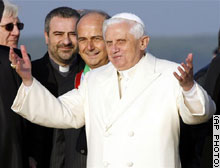
Frank sent me a link to this full-lenght picture of the Pope Coat, which gives evidence that he is even super-flyer than we first suspected - Note the snazzy red shoes!

And by the way, here is another hypothesis on why he wasn't all bedecked in Papal Regalia when he landed: Maybe it has to do with Turkey being a secular country in which it is the practice of the priests to not wear their priesty stuff in public? Anyway, I heard that in an NPR story, and it is at least as good an idea as the one about his cross setting off the airport metal detector and being confiscated!

Tuesday, November 28, 2006

Pope Coat

When the Pope landed in Turkey, he was wearing a super-fly white coat. (I am SO putting it on my Christmas list.) However, Shawn noticed he was wearing no cross, at least not apparent to the casual observer. Question is - why?

Maybe he didn’t want to look overtly Christian, thinking he might offend (or offend again, perhaps) the Muslims in Turkey?

Maybe he has a travel outfit that is more scaled down and doesn’t include all the Pope paraphernalia?

Maybe he left his cross in the overhead bin by mistake?

Maybe the cross set off the airport security alarm and they made him take it off?

Later he had the full outfit on, but when he first landed he definitely had a kind of different look about him. Here in the lobby of Drury Inn in Columbia, a few of us attending the Residents in Ministry meeting have been speculating about the theological implications of the Pope’s wardrobe.


What do y’all think?

Monday, November 27, 2006

Ordination Papers: Stick a Fork In 'Em, They're Done!

See that enormous stack of paper?

Those two VHS video tapes?

That CD filled with my last couple of months' worth of sweat and toil?

That's the stuff I'll be turning in, God willing, tomorrow afternoon in Columbia at the Missouri Conference office as one of the final steps in the process toward being ordained an Elder in the United Methodist Church. And, get this now - it will be there three days EARLY! That'll be a first for me, let me tell you!

What an enormous relief! It's just a huge weight lifted off my back to have this released. It was a great process, really. I haven't had the opportunity to reflect deeply on my theology since seminary, and I was actually grateful for the opportunity. But nonetheless, it is a joy to have it done and away.

Next step = interviews. But there's some time to pass before I have to get too stressed out about those. One step at a time!

Tidbits

Last week was extremely busy - two ecumenical Thanksgiving services at one of which my dad was the preacher, trying to cram a week's worth of church work into three days, two people hospitalized to visit, travel to Columbia, MO for Thanksgiving, then back to KC for the weekend worship services. Needless to say, blog time was limited at best.

+++

What do you do with complainers? The people who will find something bad to say about just about anything that happens drive me absolutely bonkers! One of my axioms for ministry is "Everyone needs something about which to bitch," and that holds true. BUT the question still remains how to react when the complainers take the floor.
Currently, my philosophy is not to acknowledge their complaint at all unless they can make a well-reasoned and thoughtful argument in defense of their position. If they are just complaining, though, I basically just pretend they are my best friend in the world and smile an enormous smile and change the subject. Complainers are poisonous.
Maybe I should go to church here.


+++

ALL ORDINATION PAPERWORK IS DUE THIS FRIDAY!!! I think I'm in good shape, actually, with just a few bits and pieces to clean up. Of course, the Board of Ordained Ministry has scheduled a Residents In Ministry meeting this week - Tuesday noon through Wednesday noon - that will necessitate our all driving to the conference office in Columbia and back also, basically knocking two complete days out of our week. Timing is everything! Just out of Thanksgiving, Advent starting up, ordination paperwork due, be an effective pastor in your appointment, and, o yeah, by the way, spend two days away at a required meeting right in the middle of all that.

Not that I'm complaining, mind you ... ;)

Tuesday, November 21, 2006

A Life Lesson from Wesley

My son Wesley is sick. So today, I worked on my laptop at the kitchen table while he played quietly in the living room. While I was writing an article for the upcoming newsletter, Wes calls out from the living room, “Hey Dad, it’s kinda nice with just you and me in the house.”

Caught off-guard, I wasn’t sure what to say, exactly. It was so unashamedly honest, and so purely innocent. Here is a five-year-old boy who has to contend with a big sister who wants to be his mama hen all the time, a three-year-old foster sister whose preferred means of communication is whining and stomping at him, and a toddler foster brother who takes up a huge chunk of his parents’ attention. I mean, what’s a kid got to do to get a little undivided attention around here?

The answer seems to be, “Run a fever of one hundred one and stay home from school.” Come to think of it, his staying home from school sick was the first time he had been away from other kids for ... I honestly don't know how long. At home, church, school, dance, soccer - he is always with other kids. The only time he ever gets to be alone with me seems to be when he is home sick.

And in the middle of the misery of his high temperature, runny nose, aches and pains, and periodic sneezing fits, he pauses long enough to reflect on how things feel, and he finds it “kinda nice.” And not only does he find it “kinda nice,” he also takes the time to tell me that it feels “kinda nice.” What a good kid!


Thank you, Wesley, for being who you are. And thank you for reminding me to appreciate the quiet moments of life, when a dad and a son are just hanging around together, not doing much of anything. I promise not to wait until you are sick to make time to be together, just me and you. It feels kinda nice to me, too.

Thursday, November 16, 2006

Thursday is Methoblog Day

Every Thursday, I'm signed on to be an editor of the Methoblog.
I'm still not quite sure what that means, but nonetheless, I have posted something over there. Go check it out, if you'd like.

Monday, November 13, 2006

Ordination Questions: A Few Suggestions?

In my quest for ordination, I have answered a whole lot of questions that were given to me by the Board of Ordained Ministry, some of which I have posted here. I still have a bunch to do, although it seems like I've been working on them forever.

The questions have covered all the doctrines of the church pretty much, but I have sometimes wondered, "Now why in the world are they asking me that?" as I have answered a question here and there. And on the flipside, I find myself formulating questions that they SHOULD be asking candidates for ordination, in my humble opinion.

Here are some that would be fun to answer for the board:

- What is the best way to be in ministry with a person for whom Christian Orthodoxy is a stumbling block in their relationship wth Christ?

- What's more important, making sure someone accepts Jesus as Lord or making sure someone has food in their belly and a warm place to sleep?

- List the top seventeen reasons to affirm the separation of church and state.

- Construct a theologically grounded argument to counter the assertion, "But we have never done it that way before."

- Pick a controversial social issue and write an essay arguing for the opposite of your own perspective on the issue.

- What will the Church look like fifty years from now?

At the very least, they would generate some productive conversations at the interview sessions.

How about you? Anyone reading this have any ideas for a question that everyone being ordained a pastor in the United Methodist Church ought to be asked? I know there are some Missouri BOOM members who check my blog out every now and then - what do you REALLY want to ask us? ; )

Friday, November 10, 2006

Ordination Questions: Quadrilateral and the Church

What a week.

I devoted two whole days this week (Monday and Tuesday) to ordination paperwork, and I am happy to say that I got a lot done. I’m still not completely finished, but I’m a lot further along than I was. I posted a couple of my answers below. I’d love your comments. More to come!


Theology and Doctrine:
4. The United Methodist church holds that Scripture, tradition, experience and reason are sources and norms for belief and practice but that the Bible is primary among them. What is your understanding of this theological position of the Church?

The four sources for Christian belief and practice are a metaphorical jazz combo, with Scripture as the solo instrument and tradition, reason, and experience as the rhythm section. To the tune of this combo, the church seeks to undertake our theological task, which the Book of Discipline indicates is “the testing, renewal, elaboration, and application of our doctrinal perspective in carrying out our calling ‘to spread scriptural holiness over these lands’” (¶ 104). The melody is played by the soloist, and is the recognizable essence of the tune, just as the Word of God is contained in Scripture as the primary resource for understanding God’s salvific mission in the world. The piano, bass, and drums that comprise the rhythm section are vital to the overall performance, and give an accompanying harmonic and rhythmic structure, or “groove,” for the soloist, just as tradition, experience, and reason provide the groove upon which our Biblical interpretation is done.
Specifically, the tradition of the church is a historical measuring system for testing the authenticity of our faith. This does not mean that we do it this way because we have always done it this way, but rather that we acknowledge the debt we owe to generations of faithful witnesses before us whose work for the sake of God’s mission has afforded us the opportunity to be where we are. But even a scriptural faith tested by the tradition may still be a dead faith if not enlivened by our own experience. In other words, faith has to be relevant, to make a real perceived difference in people’s lives. And finally, it has to make sense in a reasonable way. This does not discount the supernatural by any means; surely God is capable of working miracles in every moment. But there must be a kind of common sense rationality to the faith that is confirmed in its interaction with other spheres of the human endeavor.

…

6. Describe the nature and mission of the Church. What are its primary tasks today?
The church is a community called together by God to be an embodiment of God’s reign on earth and a herald of the good news of Christ Jesus. The church’s mission is to participate in God’s mission: to make disciples of Jesus Christ by proclaiming the gospel and living out the commandments to love God and neighbor, toward the end of realizing the reign of God on earth. The primary task of the church today is translation, namely, translation of the message of the gospel into a language that can be heard and understood by new generations of Christians. Of course, this has been the primary task of the church in every generation, but the sociological and cultural changes of the twentieth century have been more drastic than ever in history, including radical shifts in communication, transportation, and technological innovation, and these changes require hard work on the part of the church in order for it to continue to be relevant. Relevance is not important for its own sake, but for the sake of the gospel itself. Simply put, if the gospel of Jesus Christ is not translated into a language that is relevant, that people understand, then the church fails its mission.
Relevance is needed at all stages of church participation, which includes invitation, formation, and sending. As the church reaches out to engage and invite people into the community, it must do so in a way that will encourage participation and be enjoyable. As the church nurtures the spiritual formation of the congregation, people must experience real growth and transformation that impacts them tangibly. And as people are sent into the world to serve God by working for justice and peace, they ought to be making a real difference in the lives of the people they serve. One way to say this is that the church, in all it does, must “keep it real.” A healthy doctrine of incarnation means that a retreat into mystical, ephemeral, other-worldliness is incompatible with who God calls the church to be. The church is in the world, rolling up her sleeves and getting to work, digging into the messiness of real life.

Friday, November 03, 2006

This is NOT a Funny Post

Did anyone see October go by? Seriously, though, wasn’t it September just … like last week? I have got to slow down, or else I’ll be retired before I really get started.

+++

Please do not smile, and read this VERY SERIOUS column by Kansas City Star writer Lewis Diuguid. (You pronounce his name Do-Good. So yes, that means he is a left-wing opinion columnist named Do-Good. (Insert punchline here.))

Diuguid doesn’t want any more laughing. He thinks it detracts from the seriousness of the world’s situation. He wrote, “Laughter … deflates and diverts people’s attention from what should be a buildup of public outrage, causing folks to vote for change.” It “trivializes serious things” and “diminishes suffering.”

His column cites a study called “‘The ‘Daily Show’ Effect: Candidate Evaluations, Efficacy and American Youth.” This study proposes that young people in America are more cynical and negative about politics because we watch The Daily Show. Actually, I think young people in America watch The Daily Show because we are cynical and negative about politics. And furthermore, The Daily Show is thriving mostly because the American political scene is a joke, worthy of nothing much more than cynicism and negativity. Whatever, Diuguid then spins this study to try to prove his hypothesis that humor is deteriorating the level of public discourse in our society.

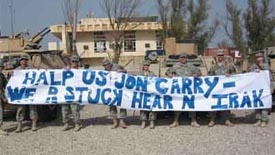
I usually agree with Mr. Diuguid, but not this time. If anything, we need MORE laughter in our public discourse. Like the soldiers in Iraq who responded to John Kerry’s recent stupid remark with a banner that read, “Halp us, Jon Carry. We R stuck hear in Irak.” Hilarious! Some people were “outraged” by Kerry’s remark – that’s their problem, bunch of fuddy-duddies. Laughing about it is a much healthier response.

Have you ever been in an emergency room and heard the banter among doctors, nurses, and staff? As a hospital chaplain a few years ago, I heard E.R. humor that most sensible Midwestern churchgoers would likely have deemed a smidge … umm … inappropriate, if not downright offensive. But when confronted with the nasty stuff they saw, the E.R. staff had a choice, either make jokes or go insane. Thankfully, they choose to laugh, and subsequently were better able to handle the stress so they could do their jobs.

When one takes oneself too seriously, a whole bunch of bad stuff starts to happen. One’s face gets all frowny and wrinkled, one’s shoulders start to hunch over, the acid produced in one’s stomach starts to eat away one’s stomach lining, and one ends up locked in a padded cell somewhere. Either that or becomes vice president of the United States. It is hard to imagine just how many problems we could fix if we would just agree to lighten up a little bit. Chill out! Relax! Don’t worry, be happy! And all that kind of stuff.

One other thing: I hereby decree that just typing “LOL” on your computer screen doesn’t count unless you actually Laugh Out Loud. Don’t abuse it, people, or else it will be taken away, probably by someone like Lewis Diuguid, who in my humble opinion is not doing anyone a bit of good by telling us to be more serious. As Dr. Seuss says, “From there to here, from here to there, funny things are everywhere!”

Tuesday, October 31, 2006

Ordination Papers - The Human Need for Grace

I have a specific question on this ordination response: do you think I should use the word "moron?" The word describes my feelings quite precisely, but will it come across too slangy? Any other suggestions would also be appreciated!


2. What effect has the practice of ministry had on your understanding of humanity and the need for divine grace?

People are morons.


Okay, that may be a little strong. Let me back off of that a little bit. The practice of ministry has illuminated for me an understanding that without divine grace, humanity would live disconnected, isolated, lives – which frequently causes us to act like morons! This isolation manifests as sin in many ways. The most insidious of these sins are pride, prejudice, and pretension. Without God’s grace, people tend toward a prideful notion of inflated self-importance that is marked by self-centeredness, arrogance, and greed. The flipside of pride is prejudice, which minimizes the worth of another person based on a quick judgment made based on and unfair association of the individual with a group rather than a real relationship of mutual respect and trust. If pride isolates by inflating the self, prejudice isolates by deflating the other.

The third manifestation of isolation is more subtle, and comes in the form of pretensions, by which I mean attitudes and actions that are intended to mask the truth by falsely claiming that circumstances are better or healthier than they really are. What is truly evil about these pretensions is the multi-layered deception involved, in which the human tendency is to pretend that we don’t notice the pretension, even when all people involved are fully aware of them. This phenomenon is what allows us to nod and mumble, “How are you?” to our sisters and brothers sitting around us at worship, even when we do not really want to hear how they are actually doing. Further, it allows the responder to mutter an equally incoherent, “Just fine” without really meaning that, and without any intention of telling the questioner how they really “are.” Pretensions separate people from one another by inhibiting true relationship based on openness and honesty.

The force that acts counter to this isolation is the grace of God, which is a uniting, relationship building power at work everywhere and at all times. And if people will accept God’s grace by connecting to one another and to God, we inevitably find that life is a whole lot easier to live. Practicing ministry has shown me that there will be times that we can help another, and times that we need help; there will be times that we can comfort someone who is grieving, and times when we grieve and need another’s shoulder on which to cry; there will be times when we can serve, and times we need to allow ourselves to be served, and so forth. This is grace. Grace is the ongoing creation of loving relationships centered around the mystery of God, and without it, we are nothing more than a bunch of morons.

Monday, October 30, 2006

Blog Milestone

Sometime last weekend, Enter the Rainbow was visited by its 30,000th hit. (Since June 25, 2005 when I put on the little counter thing.)

I wonder if this will fit into the Conference definition of "fruitfulness" in ministry?

Friday, October 27, 2006

Reverend Photog Back At It

After a month of inactivity, I have begun posting my photographs again over at Reverend Photog. I invite you to check it out.

Thursday, October 26, 2006

Ordination Papers - Understanding of God

Here you go, another answer for the Board of Ordained Ministry's questionaire, the answers to which will go a long way toward determining whether or not I am ordained next Spring. This time, from the "Theology and Doctrine" section. Comments are appreciated:

1. Understanding of God
a. Theologically describe your current understanding of God.

I feel like the closer I get to understanding who God is, the more I realize there is to know. God’s capacity to be understood is infinite, so my current understanding is a relatively minuscule fragment, a single grain of sand in the vastness of the cosmos. I know God most fully in the incarnation, Christ Jesus of Nazareth. In Jesus’ birth, life, death, and resurrection, I glimpse God at work in the world, and by patterning my life after the example of Jesus, I strive to live as God’s ongoing incarnation even now. As such, I come to understand God by striving to live as God desires, and my striving to live as God desires is informed by who I understand God to be.

I ground this dynamic understanding of God in my faith in YHWH, the God whose very name is a verb. In Exodus 3:14, It is written that God self-identifies as “I Am Who I Am” or “I Will Be What I Will Be,” thereby linking faith and action in an inextricable bond. The scriptures record the story of a God who creates, makes covenant, liberates, saves, heals, and most of all, loves. It is by these actions in history that God has been known for generations. And in Christ Jesus, God acted in the most complete way possible; God became human. In the act of incarnation, God became Emmanuel, or “God with us,” and gave the world a life pattern to follow. I have come to know Jesus through study and prayer, and I believe that as I follow the life pattern of Jesus, I come to understand more about God. That understanding then further informs my actions, and the resultant cycle of action and reflection facilitates my continued spiritual growth.

b. How has the practice of ministry affected your experience and understanding of God?
The practice of ministry has given me numerous opportunities to interact with people at many different life moments – birth, death, marriage, sorrow, celebration, and more. These relationships have afforded me glimpses of God at work in a variety of ways – a comforter for the grieving, a liberator for the oppressed, a burst of energy for the lethargic, a savior for the sinner, an uncomfortable agitator for the self-centered, a partner in joy, etc. The sheer volume of God’s capacity for active, vital, incarnate presence in people’s lives that I have witnessed and participated in over the short course of my ministry is indescribable. As a minister of Jesus Christ, it is my privilege to be able to help people name and claim the ways God is active in their lives. And as I have done so, my own knowledge and understanding of God has grown in the process, with the result that I am better equipped to name and claim how God is present in my own life.

Wednesday, October 25, 2006

I Dig Job!


Thanks to the guidance of the revised common lectionary, I have been digging into the book of Job for the last several weeks more deeply than I ever dug before. And you know what? It is a wonderful book!

I think maybe I had always simply bought into the nickel interpretation without really reflecting on anything deeper. You know the whole God-only-knows-why-bad-things-happen-to-good-people-so-just-shut-up-about-it-and-quit-complaining-you-big-whiner interpretation? But dwelling with Job these past four weeks has been like putting my hand to the flinty rock and overturning mountains by the roots to uncover the precious gems of wisdom contained therein. (see 28:9)

Por ejemplo, in chapter 31, Job’s poetic utterances are in the form of “If/then” statements. In a nutshell, he says that if he had done wrong, then he would understand being punished. Surface level interpretation might say that sentiment reflects the theology that says “bad behavior is punished and good behavior is rewarded,” and just stop there. But when you read the “if” statements alone, you get an idea of what the so called “good” behavior is. In other words, reading Job’s “if” statements gives us a glimpse of what God might require of people who want to be blameless and upright, fearing God and turning away from evil (see 1:1, 1:8, 2:3).

Job’s “if” statements from chapter 31 include:

- Lying (v. 5-8)
- Giving in to sexual temptation (v. 9-12)
- Oppressing his slaves (v. 13-15)
- Sins of omission against the poor (v. 19-23)
- Idolatry and greed (v. 24-28)
- Contempt for enemies and strangers (v. 29 – 37)
- Bad stewardship of the earth (v. 38 – 40)

In particular, the sins of omission against the poor are very illuminating. Please indulge in the following:
“If I have withheld anything that the poor desired,
or have caused the eyes of the widow to fail,
or have eaten my morsel alone,
and the orphan has not eaten from it …”

“If I have seen anyone perish for lack of clothing,
or a poor person without covering,…
who was not warmed with the fleece of my sheep.”

In other words, “How does God’s love abide in anyone who has the world’s goods and sees a brother or sister in need and yet refuses help?” (1 John 3:17) I answer = “It doesn’t.” The punishment Job describes for these sins of omission is horrific: “…then let my shoulder blade fall from my shoulder, and let my arm be broken from its socket.” (v. 22) Eww, gross! But perhaps the point is that our arms should be extended to the ones in need around us, and if they are not, they might as well not be there at all.

A close reading of Job, therefore, reveals a text that is profoundly meaningful from a social justice perspective. It is a “social holiness” book that weaves together personal piety and communal responsibility in a way that makes it nearly impossible to think about one without the other. And this is only one of the gems we have mined from the book of Job during our weekly Bible study sessions this past month. Pun intended, I dig Job!

Social Worker Murder Suspects Caught

You may already have seen this, but here is an update on the case of the kidnapping of baby Saige Terrell and the death of his social worker Boni Frederick. Saige is safe and in state custody and his mother and her boyfriend have been apprehended.

Story here.
Commentary here.
Video available here.

Thank you, God, for the life of Saige. Please continue to hold his mom in your care and give her a sense of your peace. Comfort the family and friends of Boni in their time of grief. And please send your loving spirit to be with social workers everywhere as they continue to do the tough work to which you have called them. Amen.

Thursday, October 19, 2006

A New Axiom for Ministry

I think I may have another axiom for ministry. It might go something like this:

“Everyone is busy – deal with it.”

The reality behind this axiom: In general people live full lives, and young families especially spend much of their time negotiating the complexities, so you can’t be too upset when it seems they don’t have much time/energy left to give to the church. It’s not that people don’t care, or don’t want to, or are lazy slackers or anything. The hours of their day and the days of their week are so full of living life, what they need most is Sabbath rest, not more activities, no matter how holy they might be!

Our Director of Youth uncovered this axiom in trying to plan for a weekend he would be away. He happened to hit a weekend where four or five families had something else going on, and so he was not successful in finding a substitute to lead fellowship time. However, in a marvelous little good news/bad news twist, we only have four or five families involved with our youth ministry right now, so he actually didn’t need a substitute, because everyone is going to be busy! (Don’t you love that?)

People are busy in big churches, too. But the larger numbers of people mean that the overall ministries can absorb their individual busy-ness without feeling it too much. Four or five families might be busy, but there are a dozen more who will be there. In a smaller church like ours, though, having four or five families gone exhausts our youth group, as it would several other ministries here, as well.

However, the axiom is still true: Everyone is busy – Deal with it. We can’t chastise them for not giving of themselves to the church; at the end of their week, there is just not that much left to give. So maybe the church can offer Sabbath instead of more busy-ness. Maybe one way the church can “deal with it” is to allow people to slow down a bit rather than hurling ever more new and exciting activities their direction. Maybe we ought to go deep rather than go broad.

The term “balance” keeps coming to mind. If the church throws too many activities at the people, the balance will tip toward busy-ness. If the church doesn’t have anything going on, we get lethargic. The balance point is somewhere in between the extremes.

Wednesday, October 18, 2006

Social Worker Killed

Please do not miss this story.

A Cabinet for Health and Family Services social worker for the state of Kentucky, bringing a child in state custody for a visit with his mother, was murdered by the mother and her boyfriend, who then took the baby and fled.

It happened in Henderson, Kentucky, an economically depressed area where the Red Bird Mission, a United Methodist Ministry, is located.

My stomach hurts about this one. As foster parents who work within the family services system here in Missouri, my heart aches for the worker, Boni Frederick, her grieving family and her colleagues, who must be absolutely crushed. And I am praying hard for the safe return of the baby, who is in need of care that cannot be provided by his mom and her boyfriend.

There is nothing good to say about this situation. Only questions.

What kind of pain does a mom feel that would lead her to murder?

What is the baby experiencing, what did he see?

How will this affect the way Boni Frederick's co-workers, and social workers everywhere, continue to do their vital and enormously under-appreciated work?

God, be with Saige. And his mom. Comfort those who mourn Boni's death. Soothe our troubled hearts, you who hold all of creation in your tender mercy. Amen.

Tuesday, October 17, 2006

Ordination Papers - "Style of Ministerial Leadership"

Knee deep in paperwork for ordination, I find it is time to remind myself that becoming an ordained pastor is not supposed to be as easy as printing a certificate from a website. I am grateful for this opportunity to dig deeply into my faith journey and reflect on my calling to ministry. It's just that doing so in the middle of pastoring full time, chairing the board for Missouri Ministers' School, serving as secretary of the District Board of Church Extension and Mission, ... and oh, yeah ... being a husband and a father, too, is a pretty stressful experience.

Anyway, here's another of my answers. Let me know what you think!

9. Describe your style of ministerial leadership in relationship to your congregation/setting.

No higher compliment is paid me than by the one who says with disbelief in their voice, “You mean YOU are the pastor?!” Last winter, a church member called me to say he had tickets to the Missouri Tigers basketball game, and to ask if I would like to go along. Two other guys from church were going, and I would be the fourth. The trip was great fun, and on the way home, I thanked the three men for helping me to feel “like one of the guys.” In response, one said, “But you ARE one of the guys.” I suppose I carry that “one-of-the-guys” style of ministerial leadership with me wherever I am, which makes it easy for me to relate to many different people, be they preschool kids or retirees, upper/middle class suburbanites or homeless sojourners stopping by for a cup of coffee, the longest of long-time church members or the newest of recent converts, and so on. I find that what happens when I relate well with others is that mutual trust is built within the relationships, and there is no more precious aspect of a pastor’s relationship with the congregation than trust. And there is no aspect more fragile.

The danger of a style of ministerial leadership like this is the potential deterioration of healthy boundaries. Although I may act like “one of the guys,” really I am not. I am the pastor, set apart for a lifetime commitment to ministry of service, word, sacrament, and order. I am the one people will look to for theological guidance, spiritual nurture, pastoral care in painful moments, and so forth. And this kind of role cannot be played by just any friend among many. Yet if lived out with integrity and sensitivity, an informal, familiar leadership style with the congregants may in fact enhance our relationship, thanks in large part to the trust that is established. It means that, as I engage and equip others for ministry, as I speak prophetic truth shaped by the ongoing mission of God, as I provide comfort and care for the afflicted (and occasionally provide affliction for the comfortable!), I do so upon the foundation of strong trust. They know me and I know them;we trust each other. It is a trust I am careful never to abuse, and never to take for granted. There may be some who do not take me as seriously as they would if my style was more authoritarian or managerial, but there are many, many more who respond affirmatively. (Plus it is just a whole lot more fun!)

Friday, October 13, 2006

Foster Parents

As foster parents, Erin and I are part of a team of people who are working on our kids’ case. Yesterday, we spent our morning attending our first meeting of this entire team. It was quite an intense experience. The foster care process includes this kind of meeting every now and then, just as a way for everyone to check in, give updates on how things are proceeding, and continue to work towards the goal of permanency for the kids.

Present at this meeting were the two kids, Erin and me, the kids’ mom, the kids’ paternal grandmother, the kids’ dad’s lawyer, the kids’ lawyer, the kids’ medical case manager, the kids’ case worker, the kids’ therapist, the case worker’s supervisor, a court representative, a community representative, and the Assistant Director of the Children’s Division office. So, picture all fifteen of us crowded around a conference table in a meeting room that was clearly designed to accommodate exactly fifteen people sitting around a conference table, but nothing else at all.

This meeting was the first time for us to meet the kids’ mom (and the kids’ grandmother, for that matter). Needless to say, we were feeling a TON of anxiety going in. What would she be like? Would she resent us? Would she care at all? All we knew about her was based upon what her daughter told us following their weekly visits. And of course, her daughter loves her. But was that just because all kids love their moms, no matter what? Maybe we were over-thinking this, but we were pretty nervous about the meeting, wondering what she would think of us, what we would think of her, and how we would get along with each other.

Well, despite our sense of foreboding, meeting the kids’ mom was a very positive experience. She was friendly and gentle, and very affectionate with the kids without smothering them. She held them on her lap for most of the meeting, but let them down when they wiggled so that they could go sit with someone else, mostly either their grandmother or one of us. It felt similar to a family gathering, where the kids will wander from relative to relative, trusting that any of several different people would give them a lap to sit on and a couple of arms to hug, and Erin and I were two among the several.

I say it felt similar to a family gathering, but nobody was eating barbecue chicken and baked beans off of paper plates on the front porch. Our purpose was to discuss “the case.” So Erin and I told everyone about how the kids were doing, acting, eating, conversing, playing, dressing, “getting along,” and basically everything they have been up to for the last two months. We told them about dentist and doctor appointments, about day care, about church. We talked about their temper tantrums and their moods after a visit as compared to before. We told them everything we could think of, than answered their questions for the rest of the info they needed. It was, all in all, about thirty minutes worth of conversation.

I can’t reveal very much about the content of what happened, of course, but as I reflect on sort of how the whole thing felt, I would say that the meeting itself felt very much like a step in a longer process, almost but not quite a hoop through which to jump. Most of the people in the meeting had a demeanor that said, “I’ve done this before; I’ll do it again.” We had built up so much emotion and expectation toward the meeting, that it was almost anticlimactic once we got there. But I’m not trying to say that the people were cold and impersonal. In fact, all of the people involved were very friendly and open about the whole thing, talking with the kids and trying to draw them into the conversation. It was clear that the people around the table were all there because they wanted what’s best for the kids, and that is a good thing.

One final observation about this meeting: there has been a sweeping change in the philosophy of foster care in recent years, and a lot of people just don’t understand it. For example, I spoke with a friend at church about it, and her reaction was, “Oh, I bet the kids just clung to you for dear life during the whole thing.”

I replied, “Actually, no. They pretty much went straight to their mom and sat with her most of the time.”

At this, my friend was surprised. “Really?” she said, “I would have thought they would have been scared to leave your side with all those strangers.”

I’m not sure what exactly my friend was thinking, unless it was that since the court decided the kids would be better off away from mom for a while, the kids must agree. But as a general rule, kids love moms. And in particular, though they may not have lived with her for a while, she is still their mom, not a stranger at all. Of course they went straight to her mom and sat with her. We are foster parents, care-givers. We are not their parents.

As foster parents, we are a part of a team working in concert to see that the kids are safe and healthy, both in the short term and over the long haul. That might mean they go back to live with their mom after a few more months. That might mean that they are adopted by another family. That part of it is not our decision. Only the court can decide that. Our part is for the short term – to take care of them, to love them, to keep them safe and make sure they know that they are.

After the meeting was over, I told the kids’ mom, “We’re taking good care of them.” I just thought she might like to know. After all, she’s their mom.

Tuesday, October 10, 2006

North Korea Thoughts

Adam has some good thoughts about North Korea - click here.

Rambling Thoughts: Lydia Patterson Institute

(The following is a post written by Bishop Monk Bryan, my grandfather, whose "rambling thoughts" about God, church, and life in general are a periodic feature of Enter the Rainbow, depending on how freely he will offer them!)

Last Monday I flew to El Paso; came back the next day. Our South Central Jurisdiction College of Bishops meets once each four years at Lydia Patterson Institute in El Paso and once at Saint Paul Seminary in K C. ... I was [chairman of the LPI board from]1980 to 1984. I always enjoy being with my colleagues in the College of Bishops and it was good to visit LPI again and get reconnected.

LPI is a Methodist middle and high school, founded in 1913, for the poorest of Hispanic children in Juarez (just across the Rio Grande river; now over two million population) and in El Paso. There are now about 450 students, some two thirds coming each day from Juarez. Without LPI they would have no middle or high school and would be blank as to English. Many of the Juarez homes from which they come are below our understanding.

LPI busses pick them up each morning and take them back at the end of the day. The jams at the check gates entering the U S take from one to two hours morning and evening; in winter the kids leave home before dawn and get back after dark. Yet there are few absences.

It is a risk program, considering the poverty, sometimes dysfuntional, often single parent homes from which they come. Lupita, a girl from Juarez, had planned for months to start in LPI last year. The school and a Methodist Church had worked on it, including rebuilding the family's shack home. But a few weeks before school started, Lupita disappeared. No one knows where she is. Lupita's younger sister is now in LPI and a still younger one is likely to be in two years.

Keeping in mind all the problems and struggles, there are few behavior problems, the attendance rate beats any of our U S schools. Over 90 % graduate from high school. And over 90 %, sometimes over 95 %, go on to college. Without LPI, they would know little or no English; upon graduation, all handle it well. There are working relations with our Methodist colleges, and LPI graduates are now in Centenary, Hendrix, Oklahoma City U, Southwestern U, Texas Wesleyan U, Nebraska Wesleyan U, Lon Morris, Wiley, S M U, Emory, Duke, and others.

LPI is contained to one block. There are plans to secure another half block in a year or two. And hopefully the other half of that block later. What a wonderful investment Methodism makes !!!

Monday, October 09, 2006

Ethics of the Lowest Common Denominator - Part 2

I’ll start with an observation about human beings:

It is always easier to characterize groups than to relate to real people. And so we can feel bad for “the poor” or we can sympathize with “the Amish” or we can fear “the terrorists” or we can condemn “the gays” or we can vote against “the Republicans” or root against “the Broncos” and on and on and on. All of this without risk, without any thought of giving yourself up to the other, of sacrificing something for the sake of love, of offering to serve another child of God with a spirit of compassion and grace, in short, without any of that messiness that we would call a real relationship.

And this detached state feeds directly into the ethics of the lowest common denominator (the LCD ethic, if you will), the prevalent ethic that says one needs to act only slightly better than the group or the person who acts the worst. Consider the case study of terrorism and the treatment of detainees. Good or bad, why should we be concerned with how they are being treated? After all, terrorists have killed thousands of people over the decades, using deplorable techniques, and continue to wreak havoc around the world daily. The LCD ethic would say that the standard for the treatment of terrorism detainees is set by the terrorists themselves, the whole group of them lumped together as one evil blob.

However, Christian ethics start with incarnation, which is the most intimate expression of relationship that God could ever offer. The holy mystery of the trinity, itself an intricate interplay of relationship and unity, is made flesh in Christ Jesus in order to be real, in a reach-out-and-touch relationship by which God yearns to save creation. In the incarnation, God shows up for us so that our relationship with God is no longer an abstraction, but a tangible reality. Jesus gave himself up for the world, sacrificed his everything for the sake of love, knelt down to wash each individual disciple’s feet in the last moments of his life on earth, and made the messiness of human relationship more fully real than any of us ever could.

A “what if” comment last time asked what you would do if one person in your control knew the location of a nuclear weapon that would kill millions – would you torture them? Actually, I cannot ever picture myself in that position, and I’m highly skeptical that anyone but a TV character ever would, and so it is really hard to answer. The question is actually not responsive to the observations I am trying to make in this little dyad of posts. It falls into the category of a neat Youth Group conversation starter, but is not my point.

Mostly, I’m just trying to point out that when we start assessing our behavior by comparing it to a behavior that is truly horrible, we are in pretty big trouble. And further, that our tendency to do so is compounded by our equally sinful tendency to lump individuals together into large groups that we then characterize with broad, sweeping brushstrokes. Again, I’m not talking about the actual treatment of Guantanamo detainees. In fact, in a variation on the LCD ethic, the assertion that they are being treated well as a group is just as antithetical to Christian ethics as the assertion that they are being mistreated as a group.

Rather, a Christian ethic would demand to know how each one is being treated as a child of God, and insist that the sacred worth of every person be realized and respected. And that goes for detainees, guards, support staff, administrators – everybody – which is hard to do. But thank God Christ calls us to a higher standard, and may God give us the strength we need to attain it.

Wednesday, October 04, 2006

Ethics of the Lowest Common Denominator - Part 1

One of the reasons I am a Christian is because of ethics; the ethics of Christ resonate with me in a way that feels right. I have chosen to follow him, in part, because the pattern of life that Christians are called to follow provides an ethical center that makes sense to me. With that in mind …

Somebody please correct me if I have misunderstood something with this one. I am sure that I must be oversimplifying the situation again, a habit of mine which some of my friends have been kind enough to point out in the past. I trust that if I am guilty of doing so this time, I will be duly chastised.

HOWEVER …(I am now done prefacing, on to the actual content!)…

It seems to me that some people are trying to advance the argument that, since terrorists use unethical tactics, our military should too. The argument is most evident around the treatment of detainees at Guantanamo Bay. As if, because the terrorists commit such evil, nasty, horrific, etc. etc. actions against innocent people, that justifies treating them with a lowered ethical standard, or at least, not being overly concerned about potential mistreatment or ethical violations. There is no coherence in the ethical system that says that terrorists commit atrocities, so we ought to be able to, as well.

Before I go further, it is important to note that reports of the actual treatment of detainees in the “War on Terror” vary widely, from the most horrific pictures of torture and abuse to an almost idyllic luxury. It is not surprising to note which commentators are espousing which reports. The truth is probably somewhere in between the two extremes.

The point is, the actions of terrorists should not change the ethical standards by which we live, even to the point of affecting how the terrorists themselves are treated. This should not be a “lowest common denominator” world, in which our ethics are determined by the person who acts the worst. That’s an elementary school playground worldview, in which the phrase, “Well they started it” is regarded as logical reasoning. Such ethical deterioration makes it possible, for example, for people to say, “No, I don’t approve of the homosexual lifestyle, but at least I’m not Fred Phelps.” As if his twisted perspective sets the standard.

John Wesley, writing about slavery, wrote, “Notwithstanding ten thousand laws, right is right, and wrong is wrong still. There must still remain an essential difference between justice and injustice, cruelty and mercy.” He wrote that prosperity should never be attained at “the expense of virtue.” And neither should the elimination of terrorism be achieved (if that is even possible) at the expense of our own ethics. We may make our regulations about questioning detainees as vague as we want, we may interpret the Geneva Conventions as loosely as we want, we may play with terminology to spin the situation to our benefit all we want, but right is right and wrong is wrong still.

Christ calls his followers to a higher standard.

A part of this ethical system relates to the distinction between one’s attitude toward a large, anonymous group and one’s attitude toward individual people. As I continue to think about the “lowest common denominator” ethics prevalent in our society today, I’ll post again this week about that distinction.