We are not perfect yet, but we're getting better every day!I'm in the middle of teaching an adult Sunday School class studying the doctrine of Christian Perfection, a distinctly Wesleyan idea. We are using the resource A Perfect Love: Understanding John Wesley's 'A Plain Account of Christian Perfection' and are just over half way through. In this resource, Steve Manskar has "translated" the 18th century Wesley-ese into more contemporary language which we have found very easy to understand. Marjorie Suchocki has written a very helpful, insightful, and relevant theological reflection on the text. The study guide provided in the text has not been particularly helpful, but occasionally provided us some ideas for how to proceed.It has been very good to be so Wesleyan for these past few weeks. I am remembering all over again just what attracted me to his theology in the first place. The "Way of Salvation," the strength afforded God's grace in Christ Jesus, having the image of God stamped a fresh on your heart, the emphasis on the process of the Christian life and the hope that we can and will be better people than we find ourselves presently to be - Yahoo! This is good stuff.With that said, I cringe when I hear people say that we need to "get back to Wesley," or some such sentiment. That is the wrong metaphor, and not at all Wesleyan in and of itself. Granted, Wesley was influenced by the early church, but he did not want Methodists to simply live like they did "way back when." And so he probably would shudder at the thought that present day Methodists were trying to regress into an 18th century mindset and theology. Rather, I hope that we energetically and creatively bring Wesley into the 21st century. Let's talk about a postmodern Wesleyanism that would include spiritual disciplines, an openness to the working of grace, the idea of salvation as a process/journey, etc. ... but translated into a language that 21st century people can hear and understand. In fact, I think that is what Manskar was trying to do with A Perfect Love.We cannot spread scriptural holiness through0ut the land by simply replicating everything John and Charles did more than 200 years ago. But there is too much to learn from what they did and who they were to simply ignore them. We are Methodists; let's learn what that means, embrace it, and take the next step together toward perfection in love.More Wesleyan thoughts to come soon ...
The past four days have been in the category of “insanely busy” for me. I can barely even begin to convey the amount of activity that I have experienced. Curse this sunny weather, what I need is a couple of snow days! You know, sixteen inches of snow on top of an inch of ice with temperatures in the low teens – stuck at home, darn it, and no possible way to get out to do anything.
Anyway, enough with the “Oh, I’m so busy” schtick …
One of the things occupying my time these last few days was our district’s Lay Leadership Training event, at which I was leading a workshop titled “The Ministry of Young Adults.” (See my two previous posts for some more info.) Overall the workshop went really well, I thought. There were twelve people in my workshop (over 200 attended the event), representing five different churches.
The first thing we tried to do was get past thinking of young adults as objects, rather than subjects. We talked about the dangers of using terms like ministry “to” young adults or “for” young adults or even “with” young adults, since this thinking artificially separates young adults from the church and makes the church the primary actor and the young adult the passive recipient. Instead we thought about ministry “of” young adults, which is a mindset that affirms that young adults themselves are the church and not a separate animal, and that we have inherent gifts and graces for ministry.
 Using a set of four case studies, we tried to expand our idea of what “church” is. We tried to avoid any gimmicky, “Easy button” style ministry. It was good to see that most people have abandoned thinking, “If we could only get the right curriculum, we would have young adults here” or “If we only had a guitar player…” or “If we could just get a big screen in our sanctuary…” etc. etc. Making the church vital for young adults involves a shift in thinking, not the addition of a new program.
Here are some other insights of the workshop:
- Most people think of young adults as younger versions of themselves, when in reality young adults are a diverse group: different ethnically, racially, socio-economically, children or not, married or not, in school or working or not, etc. So when a church seeks to enhance the ministry of young adults, it is a much broader endeavor than most churches are envisioning.
- Young adults respond to authentic relationships more than fancy programs. If a church has passion and energy, if a church “keeps it real,” if a church allows people to participate together in something they can take home with them with some relevance to their lives, then the struggle to engage in young adult ministry will not be such a struggle.
- It is not a matter so much of getting more young adults into the church. It is a matter of re-thinking what church is such that young adults know that they are the church, wherever they happen to be.
- Saying, “We have always done it that way, so we are not changing,” is not faithful to the commandment to love your neighbor, since reaching out to new neighbors may involve changing things. Saying, “We have to change or we are going to die,” is not faithful to the commandment to love God, since it is focused purely on self-preservation and maintaining the bare minimum, rather than participating in the abundant life to which God calls us. Rather than either of these, we need to think of this call as, “Change as an act of faith.” In other words, we must change, but not in order to preserve the church. Rather, we must change because God is calling us to do so.
Although there was more we discussed, these are the most fundamental things we talked about for that hour and a half last Sunday. I hope that some good happened, some seeds were planted. I know that I really got a lot out of it, and learned a bunch from the people there. I just want the church to be a place where all people, young and old, feel like they can encounter the living presence of God and form meaning for their lives.
According to our Conference definition, I have but one more year to be a “young adult.” After that, I’m not sure exactly what I will be; I guess I’ll have to grow up or something. ;)
Thanks for the comments on my last post about the Young Adult workshop I'm leading. I am going to utilize many of your thoughts tomorrow afternoon. I'll be sure to give full credit where it is due ;)Seems that one important theme is to beware of thinking that the latest gadget, worship trend, or other gimmick is going to fix everything. Adam M. said, "it's authentic relationships that keep the church growing, not smoke and mirror 'modern' worship." Similarly, Adam C. wrote, "The last thing I want to do is cater to the consumer lifestyle by adding a guitar just because I think that is going to get young people." Authenticity and relevance are values that young adults hold in high regard.Another important theme is to promote an outward focus rather than inward. Kyle asks, "[Young adults] have moved into our community but is knocking on doors or leaving a brochure the best method now?" Dave's practical suggestion was to "take them out into the world and go see a concert, go bowling, see a movie, etc." Before starting any ministry at all, Brad says, "The first question any church should ask is who's our audience. Who's in our community?" In other words, the issue is to reframe the situation from "bringing more young adults into the church" to "taking the church into your community and into the world."The third theme I hope to be able to communicate tomorrow is that young adults are individuals living in community, not a homogenous generation. For example, Mike pointed out a key difference between young adults who are parents and those who are not. Dave wrote, "[Young adults] are ready to think for themsleves, and find out who they are." Kansas Bob notes that people want a church that helps them "experience God's presence and actually brings them closer to the Lord." And the reality is that each person does that in a way that is personally unique to who they are created to become.I am going to use scripture, the Book of Discipline, the thoughts of Bishop Schnase, a few case studies, and hopefully a whole lot of group discussion during the session tomorrow. Keep me in your prayers. I'll let you know how it turns out!
I'm leading a workshop on Sunday afternoon called "Ministry of Young Adults." It is a part of our District Lay Leadership Training event.In the workshop, I am going to refer to the remarks of Missouri's Bishop Robert Schnase that he has posted on the Missouri Conference website. Here is a bit of what he says.The average age in our conference is 57, the average age in our society is 33.
Each generation speaks a different language.
And more...A hundred years ago you might have had three generations in church that shared the same preference in worship style, music and entertainment. Now you may have four generations, each with their own distinctive preferences.
Finally...In 20 years, we’ve lost 40,000 by simple attrition, but haven’t replaced them. It’s not that everyone just up and left. It’s a front door problem, not a back door problem. The older generations are being asked to do what is so hard: to support music and worship styles that are foreign to them. But we must understand we have to reach these younger generations and there is a limited time to do that.
Do these thoughts ring true for you? I am happy to say that the average age of the new members we recieved here last year is 35. (And that includes one 95 year old woman in the mix!) But the reality to which Bishop Schnase points is alarming, indeed. Speaking in a sweeping, possibly unfair, but nonetheless-containing-a-kernel-of-truth generalization, people in their 20s and 30s talk, look, and think differently than older people. How is the church responding?So I ask, if you were leading a workshop on "Ministry of Young Adults," what would you say? Or perhaps, if you were attending a workshop on the topic, what would you like to hear?
 The painter had stepped away for a few moments, leaving the work to sit in the air. Her representation of reality was exposed to anyone who happened to walk by with a camera. The expression of her artist's eye, the most personal of gifts given by her Creator, a manifestation of the intimate inner-workings of her creative impulse: laid bare for the casualest observer's intrusion. I felt a bit like an interloper, an invading force, a violator of a private space. But I also felt a great sense of wonder at the vulnerability of the painter away from her easel. Was she not frightened that her creation would be vandalized, or perhaps knocked over by a sudden strong gust of wind? What a risk she took! What trust; what strength of character! She had put her idea out there in the middle of the sidewalk and then stepped away, allowing anyone at all to make anything they wanted out of it.Kind of like a preacher, isn't it? A preacher pours out the innermost depth of her soul into every phrase of her sermon. A preacher studies, looks, prays, listens, studies some more, then lays bare her representation of reality for the congregation who has come to worship. Bold colors, subtle brush strokes, the interplay of light and shadow, all are painted onto the sermon's canvas with the skill and passion of a creative mind and an artist's eye. The most personal gift given by the preacher's Creator, exposed to the casualest of observers.Then she steps away. Tired and sweating, she leaves the sermon there in the middle of the sidewalk, where malicious vandal or errant gust of wind may find it. What a risk she took! What trust! The preacher cannot guard with jealousy every jot and tittle of sermonic pronouncement. She must step away, and allow the words to sit in the air.Maybe someone will come by with a camera.Then again, maybe not.Then the painting is gone, and the preacher gets started on the next.
Well, everyone, Enter the Rainbow is one year old as of this week. Click here to read the first post I wrote.
You gotta check this out: click here.
For two weeks now, the lectionary has led us to consider stories of people being called to follow Christ. Last week it was John 1:43-51, where Philip and Nathanael get the call. This week we are reading Mark 1:14-20, in which Simon, Andrew, James, and John are invited to follow. It is one of the functions of the church to continue this ministry of making disciples of Jesus Christ. What does that look like in today's world?Too often, deciding to "follow Jesus" merely involves quitting all of your bad habits and adopting new, good habits. When we die to our old life in order to be born anew in Christ, we tend to consider that old life as comprised of all the nasty stuff we want to eliminate - partying all night, smoking, sleeping around, cursing, drinking too much, etc. We leave that stuff behind and give ourselves to Jesus, as if Jesus is some divinely sanctioned self-help program.But what was so bad about the lives of Philip, Nathanael, and the four fishermen? It is likely that they had a few bad habits, to be sure, but the scripture does not mention this. No, these are not examples of quitting the bad stuff in order to start living right. The disciples are invited to leave their perfectly fine, good, healthy lives and follow Jesus. Nathanael is affirmed as a person "in whom there is no deceit." He is a good person who is invited to leave it behind. Simon and Andrew are fishing, like they did every day, and they leave their nets (not their bad habits, notice), to follow him. James and John are working the family business with Zebedee, whom they leave behind (their own FATHER) in order to follow Jesus.The point is not that we just give up the BAD stuff to follow Jesus; the point is to give up the GOOD stuff, too! Let's not minimize the demands of Christian discipleship by reducing it to a method for personal improvement. Accepting Christ into your life CAN eliminate all that "bad stuff," but the person who comes to Jesus based on that foundation has built a shaky house, indeed. The moment the temptation and opportunity to engage in that "bad stuff" arise again, Jesus leaves the scene.John Wesley encouraged Methodists to pray as a part of the renewal of the covenant, "I am no longer my own, but thine....Let me be employed by thee or laid aside for thee, exalted for thee or brought low for thee.
Let me be full, let me be empty.
Let me have all things, let me have nothing. I freely and heartily yield all things to thy pleasure and disposal."The point being, give it ALL over to God, not just the "bad stuff." I'm not sure the church is doing such a great job in communicating that message to the world. "And immediately they left their nets and followed him." All of us are at heart just regular folks trying to live our lives as best as possible. It is into these regular lives of these regular folks that Jesus comes and says, "Follow me."P.S. - (This little extra bit seems to fit in somewhere, but I couldn't make it flow into the rhythm of the post above. Enjoy this bonus material at no extra charge!):
I think U2 is onto something with their song "Walk On." On the journey into life, "the only baggage you can bring is all that you can't leave behind." And then there is a list of all of the things that you can and should leave behind: "All that you fashion. All that you make. All that you build. All that you break. All that you measure. All that you steal. All this you can leave behind. All that you reason. All that you sense. All that you speak. All that you dress up. All that you scheme..." That doesn't leave very much, does it?
Senator Sam Brownback wrote a guest column in the Kansas City Star today giving homage to Martin Luther King, Jr. (This, by the way, is the new definition of irony.) Brownback writes, "King dedicated his life to the advancement of individuals in need," (italics mine)But I say, the advancement of individuals in need is hardly what King was dedicated to. Oh, he was in favor of it, to be sure. But he was dedicated to nothing less that the transformation of society and the establishment of justice for all people in America and throughout the world. Brownback makes King sound like he ran a local food bank. Running a food bank is an awesome ministry, and worthy of much gratitude, but King was about something more fundamental and communal than that. There is a difference between doing the works of justice that King did and doing the works of mercy that happen in food banks every day. Brownback writes, "King’s commitment to the advancement of those in need not only transformed our once oppressive society into a symbol of freedom and democracy, but he also ushered in a new consciousness of the importance of charity toward each another." (italics mine)But I say, oppression in our society is not a thing of the past. The way Brownback writes, you would think that King's dream is realized and there is no more work to do. There has never been a more noticeable difference between rich and poor in the United States. Prejudice against women and minorities is alive and well. The very young and the very old in our society are systemically devalued. No, there is still plenty of work to do before our country attains the high ideals King attempted to hold us to.More Brownback: "We most truly live up to the legacy of King when we help others."But I say, we most truly live up to the legacy of King when we unflinchingly stare injustice and oppression in the face and insist that things must be different than they are, in spite of the threat or even the act of violence perpetrated against us. King would not have received death threats and eventually been assasinated if all he had wanted was for us to "help others," like Senator Brownback seems to think. The legacy King left the world was much more profound than offering a helping hand to a neighbor in need.I applaud the good Senator's effort to highlight the importance of acts of mercy, or helping people in need. We do those acts every day here in Northtown. But to blunt the force of Martin Luther King's impact on our society by trying to make him just another social worker doing good things is an offense to the truth. King was an extremist, and demanded that we all be, as well. In his letter from Birmingham City Jail he wrote, "So the question is not whether we will be extremist but what kind of extremist we will be. Will we be extremists for hate or will we be extremists for love? Will we be extremists for the preservation of injustice - or will we be extremists for the cause of justice?"And read this closely, from the same letter: "The contemporary church is so often a weak, ineffectual voice with an uncertain sound. It is so often the arch-supporter of the status quo. Far from being disturbed by the presence of the Church, the power structure of the average community is consoled by the Church's silent and often vocal sanction of things as they are." *Sigh* There is still so very much work to be done. And honoring the legacy of Martin Luther King is more that closing the Post Office and writing a check to mail to the food pantry. As King put it, "If the inexpressible cruelties of slavery could not stop us, the opposition we now face will surely fail. We will win our freedom because the sacred heritage of our nation and the eternal will of God are embodied in our echoing demands."
 I have been away for a week at Missouri Ministers' School, an annual continuing education event for the United Methodist clergy in the Missouri Annual Conference. This year, our faculty included Willie Jennings, Ruth Duck, and Philip Wogaman. The theme of the conference was reconciliation, with the title, "Can Holy Ground Be Common Ground?" The conference was really good, but I think it was a little heavy on the "theory" and kind of light on the "practice." There were some excellent theological conversations that left me asking the "So what?" question. In other words, how exactly is the church supposed to live this out in our "ministry of reconciliation" in the world today? Another observation, our faculty this year were obviously somewhere on the left side of the theological sphere, and espouse ideas that might be labelled "liberal" or "progressive." They basically agreed with each other the whole time. (And, I must say, I basically agreed with them the whole time, too!) However there was no counterpoint offered. There was no one whom we might label "conservative" there to offer another perspective of reconciliation.So it leads me to wonder, what does the ministry of reconciliation look like to people with a different theological perspective than Phil Wogaman et al? Is it as simplistic as saying, "Reconciliation implies assimilation and homogeneity"? In other words, in order to be
  reconciled with "us" you must become like "us"? Surely not. That sounds like the Borg, not the Church. And yet, to me, that is how it seems. Please correct the error of my thinking here if I am wrong, but a lot of contemporary Christianity seems to think that reconciliation means we can be together as long as the group with less power becomes like the group with more power. (And that seems to apply to independent churches as well as mainline protestantism, I am sad to say.)This last week, even without a healthy counterpoint, the faculty of the Missouri Ministers' School sketched a picture of reconciliation that shows us living together in Christ even in spite of our differences. And I wonder, had a more conservative lecturer been there, what would she or he have had to say about that?
Vinny commented on my last post: "Man, get beyond this one-dimensional thinking." I'm not completely sure if he was commenting to me or one of the commentors, since he used the salutation "Man," which I assume is a generic "Hey you," and could referred to anyone. Nonetheless, in responding to his remark, I would like to just say "Amen" and I hope no one interprets my own thinking as one-dimensional. Phil Wogaman talks about the metaphor of a diamond cut into multiple facets. Every facet of the diamond allows us to get a glimpse of the center of the jewel, but from a different angle and with a different resultant sparkle. The "truth" is the center of the diamond; our individual perspectives are the facets.I like it! I've got my facet, you have yours. Now let's talk about our facets and how they illuminate the truth for us, with the faith that, at the core, it is the same truth that is being illuminated.
Back in October, I wrote about the difficulties of dialogue. I offered the observation that the real difference in our society is not between "liberals" and "conservatives" but rather between "idealogues" and "contextualizers." There are right-wing and left-wing idealogues, and they are pretty busy bashing each other over the head with their respective perspective. Most of us, however, are contextualizers, able to see that the different circumstances of our lives have shaped us into who we are and what we believe. Contextualizers may disagree with one another, but at least we can talk together.(Unfortunately, you have to be an idealogue to make headlines.)Enter a wonderful column by Ellen Goodman in Wednesday's paper. Goodman draws from Philip Tetlock's book, which in turn uses Isaiah Berlin's essay. (Got that?) Anyway, Berlin uses the characters of the hedgehog and the fox to describe the way people think. Quoting Goodman, "The close-minded hedgehogs are those who know 'one big thing' and relate everything to that single, central vision. The open-minded foxes 'know many little things' and accept ambiguity and contradictions." In public discourse, what we hear most are hedgehogs battling; there is no air time for foxes.The church has hedgehogs, too. The church is filled with people who believe one big thing, and any evidence to the contrary is minimized or ignored altogether. For example, I would say that a Christian who believes the church is only a social justice agency and minimizes or denies any personal salvific relationship with Jesus is a hedgehog. In addition, a Christian who believes that once you accept Jesus as your personal Lord and Savior everything will be fine and if all the poor, hungry, homeless people would just accept Him too their lives would be better, is also a hedgehog. The question is not whether you are liberal or conservative; the question is whether you are a hedgehog or a fox.Of course, if the idea in which you stake your belief is big and vague enough, you can make the case that being a hedgehog is a good thing. Like for example, you could say, "The one big thing I believe is that God is love, and everything else is related to that." Or your "one big thing" might be that Jesus is Lord or that there is no God but Allah and Mohammed is his prophet or that the Flying Spaghetti Monster is reaching out to touch the world with his noodly appendage. But if you make your "one big thing" too broad, it misses the point of the metaphor at hand.God's world is a wonderfully diverse and ever changing mix of differences, contrasts, and tensions. Each of us chooses how we deal with that reality. Either curl up and put out your spines like a hedgehog, effectively defending yourself against all threat but blind to any goodness. Or engage the ambiguity and difference with cunning and cleverness like a fox, so that your nose might get stuck a time or two but you will grow better from your life experiences.
I just want to ask y'all, about Pat Robertson, on a scale of 1 to 10 (where 1 = "ignore him because he is an irrelevant joke" and 10 = "actively seek his downfall because he is doing great harm to Christianity") what do you think we should do?
 New Year’s Resolution for 2001: I will read at least 20 good books this year.
…for 2002: I will read at least 10 books this year.…for 2003: I will read 5 books sometime before I die.…for 2004: I will finish The Pelican Brief.…for 2005: I will try and finish the comics section this year.
(from www.ahajokes.com):
It is January 2006, and time to make some resolutions again. Sure, it’s arbitrary. In 46 B.C.E. Julius Caesar established the date as a part of the Julian calendar. Sure, it doesn’t make any sense to start a year in the middle of winter. Beginning of spring would make a lot more sense; that’s when the ancient Babylonians celebrated. And by the way, the ancient Babylonians also began the practice of making a new year’s resolution. Their most common one was to return borrowed farm equipment.
(from http://wilstar.com/holidays/newyear.htm)
But in spite of all that, there’s no reason not to engage in this annual ritual of self-improvement; it’s always a good idea to try to be better people than we are. In fact, I’ve come up with some resolutions I would like to make on behalf of the church.
- This year, the church will be less about membership than about discipleship.
- This year, Christian unity will be more about the mystery of God’s grace than about the uniformity of human belief.
- This year, the church will be more concerned about how we are growing spiritually than numerically.
- This year, the church will practice radical hospitality, passionate worship, relevant faith formation, risk-taking mission, and extravagant generosity.
How’re those? Admittedly, these are a little more difficult that cutting back on between-meal snacks. But I think they are at least equally as important. So let’s use this totally arbitrary, middle of the winter, just-another-excuse-to-throw-a-party occasion to try to be a better church than we are. With God’s help, the year 2006 may just be our best year ever, on our way to living in the perfect love of God. Happy New Year, everyone!
 The Sunday School time on Christmas morning at my remarkable congregation will feature a “Birthday Party for Jesus,” complete with songs, gifts, and birthday cake. When my four-year-old son, Wesley, heard this news, he was quite overjoyed. It blew his mind to think that we would get the rare opportunity to learn about Jesus on his actual birthday! This was a pleasure that was almost too wonderful for him to comprehend.
After several minutes of giggling with delight at the notion, he said, “Yeah, and I’m going to hurry up and eat all the birthday cake before Jesus can get any.”
Now, at first that remark is worth a chuckle. It’s one of those “kids say the darndest things” moments. But listen underneath his words and hear the faith of a child being expressed. Wesley really expects Jesus to show up on Sunday morning to attend his birthday party. He knows with certainty that Jesus will be there and will, in fact, be expecting birthday cake. In his childlike innocence, Wesley has articulated the doctrine of incarnation more succinctly than any theology text book ever could.
What would happen if we all went to church on Sunday morning and really expected Jesus to show up?Merry Christmas, everybody.
 Advent observation: It is easier to preach “baby Jesus” than to preach “John the Baptist.”
This year, I have intentionally gone a little “prophetic” for my Advent sermon series. There haven’t been many fluffy sheep and warm, cozy stables. No “little Lord Jesus no crying he makes.” I have shied away from the stale “remember the reason for the season” messages that do nothing but reinforce rampant consumerism, only now you have a divinely sanctioned reason for it.
No, this year I preached justice. This year I preached faithfulness. This year I preached counter-culture. I named oppression for what it is and got fairly specific: death penalty, racism, homelessness, affluence and poverty, war. I didn’t exactly deliver John’s “brood of vipers” line, but I am hopeful that my four Advent sermons were at least challenging enough to, if not compel people to repent, at least lead them to consider it as an option. I tried to be a little bit of John the Baptist, minus the camel hair and locusts, of course.
But it was hard work. All four weekends left me pretty much wrung out exhausted. Knowing that what I was going to say would upset some people, then going ahead and saying it anyway, then standing in the back of the room to smile and shake people’s hands as they left the service was an exhausting series of events. It is so much easier just to say things that make people feel all snug and sparkly. An old friend, Kurt, told me once that a choral concert I had conducted left him feeling “as though he had been dipped in Christmas.” That’s easy to do. Requires neither valley lifting nor mountain lowering.
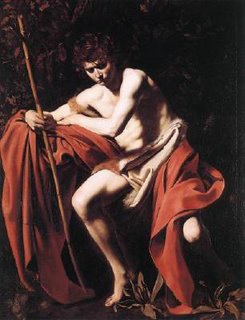
But we can’t let our faith get stuck at the level of a nativity set. (Especially one of those big lit-up plastic ones in some families’ front yards.) It is hard work, but we have got to go deep into our own hearts and confront that which separates us from God, name it, drag it up to the surface into the light so that we can once more become the people God desires us to become. And sometimes that process requires the impetus of a prophetic voice in the wilderness, even an exhausted one.(Pictured: "St. John the Baptist" - Caravaggio c. 1604; Nelson-Atkins Museum of Art, Kansas City, Missouri; click here.)
A lot of people have asked me what I make of this whole alleged anti-Christmas movement in our society. You know, the retail employees being forbidden to say “Merry Christmas,” the president sending out holiday (means "holy day" ... hmm?) cards rather than Christmas cards, rampant uninhibited heretical denial of the doctrine of the virgin birth, and stuff like that. I understand that some people are very upset by the whole thing, and have made it their personal crusade to spread Christmas cheer with all the vim and vigor they can muster. Cool.
(Aside: There’s nothing like someone wishing you “Merry Christmas” with a chip on their shoulder. There’s no feeling quite like the feeling of knowing that the well-wisher on the other side of the greeting has a militant agenda – “You WILL have a Merry Christmas, so there, you wanna make something of it?”)
Everybody needs something about which to bitch. That’s number seven in my list of axioms for ministry. It means that people are much happier when they have something tangible they can complain about. Ironically, being mad makes them happy. The current hubbub about the de-Christmasification of our culture is the latest on that list. It gives people a good, healthy sense of moral outrage, and a definitive place they can direct it. Sadly, it appears to be a reversal of a formerly en vogue complaint that is now woefully out of fashion.
See, we used to say, “Isn’t it terrible how all the stores have commercialized Christmas? It cheapens and demeans the birth of Jesus to see the holy event used to make a profit.” But now we seem to be saying, “Isn’t it terrible how all the stores have de-emphasized Christmas? It dishonors the Christ child to avoid using his birth to make money, while respecting the beliefs of non-Christian customers.” (Because, you know, respecting other people’s beliefs is not at all a Christian thing – we are all about the imposition of what we think all over your heathen self, and making a lot of money in the process.) And here’s another interesting thing: I saw an add in today’s paper for a “Christmas Party” that was being thrown at a strip club. Whoa! Theologize on that one for a while! You wanna talk about commercialization?
Indignantly, the overwhelmingly huge Christian majority who has a place of worship on every corner of every city and town across the continent, seasonally appropriate music to listen to on the radio since before Thanksgiving, and holiday-correct decorations to purchase in any given store for weeks now (not to mention the strip club parties), is trying to claim we are being oppressed. To paraphrase my Lord and Savior Jesus Christ, “O, us of little faith!”
In Matthew 8, the big faith of a Roman Centurion facilitates Jesus’s healing of his servant, whereas his disciples cower in fear as a storm threatens their little boat. This prompts J.C.’s “little faith” rebuke. Seems that today’s disciples are engaged in a similar response to the anti-Christmas storm threat we perceive. “Storm’s a-coming! Jesus, bail us out here!” To which Jesus shakes his head in frustration, sighs a deep sigh, and watches the Charlie Brown Christmas special on T.V., muttering about his disappointing disciples all the while.
So as for me, I will not lament the fact that stores seem to be removing Jesus from their marketing campaigns or the president is removing Jesus from the cards he will be sending to people of many different faiths. I happen to think the church should be insisting on just such a removal (not to mention the strip club parties) and calling for the return of Christmas to the venue of the body of Christ. I long for the good old days when Christians didn’t get so easily mixed up between their local church and their local Wal-Mart.
Ho, Ho, Ho,
Andy B.
 Pictured at right is the sight that greeted me as I arrived at church a couple of days ago. It is what it appears to be: a spare tire with a Christmas card taped to it.
The euphoric family sledding down the front of the card is saying, “May you and your family share a world of joy this Christmas.” Pictured are presumably a mom, a dad, their two kids, and grandfather tucked in the midst of them.  That’s three grown adults and two mid-sized children careening straight at the reader on an out of control toboggan to which mom is holding on with only one oven-mitted hand. I’m not sure where grandpa is holding on.
On the card was written this message with black marker: “Dear First United Methodist. Here is something for your next garage sale. See you soon!” And it is signed. The tire itself appears to be a typical, temporary spare tire. In fact, stamped on the side of the tire are the words, “Temporary use only.”
It is definitely one of the most … unique … Christmas gifts I have ever received on behalf of the church. The sight of it leaning there against the door was quite the surreal experience, and I’ll bet will be a singular occurrence over the course of my ministry, however many years I am at it.
The more I think about it, though, the more touching it is. The giver evidently saw the spare tire sitting there (wherever “there” happened to be), and thought, “You know, that Methodist Church has a garage sale every now and then, and I reckon they ought to be able to sell this here perfectly good spare tire for a few bucks. I think I’ll load it up in my trunk and bring it on down. And while I’m at it, why don’t I turn it into a nice Christmas gift?”
After all, this is the season of gift giving, and it is a rare kind of extravagant generosity that would cause a person to look at a dirty spare tire and think of the church. And so I am happy to accept this gift out of the generosity of this kind heart. I suspect that the widow’s two coins were considered an odd gift, as well.
The church will receive more valuable gifts this Christmas, but none more sincere. 
 I’m sorry I haven’t posted in a while. I had a thing. You know, I was “busy.”
How many times have you heard someone mention their busy-ness in the past few days or weeks? I personally have spoken those words more than a few times, in various tones of voice. There is the too-tired-to-move, “Oh, I’m so busy…” There is the there-is-no-way-in-heck-I-will-ever-get-this-done, “Arrgh, I’m so busy!” And then the ever popular my-Advent-has-got-to-be-so-much-more-hectic-than-your-Advent-so-get-out-of-my-way-you-pathetic-slacker, “Sorry, I’m just so BUSY!”
This is the time of year that clergy and other church staff smile at each other and say, “It’s that time of year, isn’t it?” then we chuckle and go right ahead with whatever insane busy-ness we were up to before pausing those few moments to comment on the insanity itself. The season of Advent just seems to fill up with business (and busy-ness) that we can’t avoid, … and maybe we shouldn’t.
Remember that bumper sticker that said, “Jesus is coming: Look busy!”?
Is there some kind of a spiritual discipline in ordering the busy seasons of one’s life? All of this burst of activity in preparation for the birth of God’s Messiah – maybe, like all things, it’s okay in moderation. After all, this is a pretty significant birth for which we are preparing, isn’t it? Our activity is driven by no less that Christ’s new entrance into our lives, something for which we have quite a bit of preparing to do. Our “to do list” is long, and we had better get busy: open up, get into receiving mode, spruce up our lives a little bit (or maybe even a lot).
This is not to say that we are to participate in a kind of holiday style works righteousness. The things we do do not earn our salvation. All of this Advent activity is voluntary. We choose to vacuum the living room when guests come over; it is not required. Similarly, we choose to engage in Advent business when the Guest is coming over, though it is not required. And some Christians would do well to recall that faith without works is dead. Or said another way, The grace of God does not imply passivity on the part of the receptors.
I am tired tonight, and a lot of my weariness is due to the preparations that are a part of this Advent season, and a part of ministry in general. But it is, as my mom sometimes says, a “good tired.” It is a tired resulting from Advent activity in preparation for Christmas. It is a tired with a sense of accomplishment behind it. I’m not going nuts; I know when to slow down and when to take Sabbath rest. It's all about balancing activity and rest - the both/and - the yin/yang.Yeah, sure I’m busy. But - Jesus is coming! So let's get busy!
More on University of Kansas Religious Studies Department Head Paul Mirecki's Intelligent Design course: as of yesterday, it has been withdrawn.
 Well, now we know why K.U.'s mascot is a chicken!
(Just kidding! It's a joke, relax!)
Professor Mirecki himself requested that the course be pulled. In the K.C. Star, he is quoted as saying, "Students with a serious interest in this important subject matter would not be well served by the learning environment my e-mails and the public distribution of them have created. ... It was not my intent when I wrote the e-mails, but I understand now that these words have offended many on this campus and beyond, and for that I take full responsibility." So he is pulling the class, which already had 25 students enrolled, by the way.
Is he chickening out? (shrug) Maybe. But the chairman of the faculty senate was quick to say that while controversial issues are not avoided at K.U., they should be addressed in an "appropriate, respectful manner ... Making fun of individuals is not part of the way we as a faculty want to conduct ourselves." So it is not WHAT Mirecki was saying, but HOW he was saying it that led to the current bru-ha-ha. And that's what Tim Sisk was saying in his comment on my last post. (Nice call, Tim!)
So many issues to dwell upon ... so many questions I could focus on here ... let's see ... Oh! I've got one!
In the mix of all this crud, Wichita Representative Brenda Landwehr said this: "It's hard to teach religion if you don't believe it." Go ahead and read that statement again, because it is an important topic. Can you teach religion at a public university without "believing in" the religion you are teaching? Could I as a Christian teach a class about Islam, Buddhism, Judiasm, etc.? Could a Muslim teach about Christianity? Could an agnostic teach religion? Could an athiest?
Ironically, Rep. Landwehr was trying to ensure that professors at K.U. are not guilty of religious intolerance when she offered this quote. She wants professorial bias eliminated on the one hand, but on the other seems to want only believers teaching about the religions they believe. See the disconnect? If she really wants unbiased, seems to me that an agnostic would be the perfect person to teach about religions at a public university, so long as they were equally skeptical of every faith!
We also need to carefully distinguish between teaching about religion and teaching religion. I teach Christianity in confirmation class. A college prof teaches about Christianity in a university class. The distinction is that teaching Christianity attempts to instill belief whereas teaching about Christianity attempts to impart knowledge. One is for churches, one is for schools. Let's keep it that way, okay?
And in another story in today's paper, it seems that "'Intelligent design' advocates plan to introduce proposals in Missouri next legislative session." CRAP! Now we won't be able to make this thing all about "as big as you think" Kansas! Get ready Missouri, the anti-intellectual kettle of ultra-conservate Kansas is leaking, and it is heading our way!
Bok-bok Jayhawk!
(Joke, relax!)
 “The fundies want it all taught in a science class, but this will be a nice slap in their big fat face by teaching it as a religious studies class under the category ‘mythology.’”
- Professor Paul Mirecki
Chairperson, Department of Religious Studies, University of Kansas
“I have assured the provost of the university that I will teach the course … as a serious academic subject and in a manner that respects all points of view.”
- Professor Mirecki, in his subsequent apology for the remarks above
“…it is especially appropriate that intelligent design and creationism be treated as academic subjects in a university-level religious studies class.”
- David Shulenburger
Provost, University of Kansas
Just the latest from the state of Kansas, sports fans! (A reminder: I live in Missouri.) Kansas’s new slogan is, “As big as you think.” And if this is an example of how big they think, it must be a very small state, indeed. ;) The story in the Kansas City Star this morning was accompanied by a kick-butt column by Mike Hendricks, who gets the award for the quip of the day:
“But as everyone knows, spite is never an accepted rationale for offering a college course, except those math courses that English majors are required to take.” Nice one!
As far as I can tell, at first Mirecki wanted to teach ID as a “special topic in religion” in the realm of mythology out of spite, in order to make a political statement and make a jab, er…I mean “slap” at religious fundamentalists in his state. Specifically, a “slap in their big fat face.” (Sidebar: Who says things like “big fat face” and they’re not in junior high school?) But now that his email got into the public discourse, he is back-tracking as fast as possible.
Now he and the provost are rushing to claim that intelligent design is actually a serious academic subject, something it most definitely is not. It is an article of faith, and a weak one, at that. Someone correct me if I’m wrong, but isn’t intelligent design based on being UNable to explain what you see? As in, “Golly, that amoeba is complicated; I’ll never be able to explain that; someone smarter than me must have designed it; I know – let’s call it an ‘intelligent designer.’” Then we decide if this intelligent designer exists and who s/he is based on our faith experience. That’s pretty much it, isn’t it?
And aren’t academic subjects, on the other hand, based on being ABLE to explain what you see? As in, “Golly, that amoeba is complicated; let’s figure out a way we might be able to explain how it works.” Then you look at it closely and over time, learning more and more about it by observing it. What is “academic” about shrugging your shoulders and saying, “I dunno” when confronted by life’s most difficult questions?
And think about it, what is even “faithful” about such an approach? Should we really, created in the image of God as we are, think that anything too complex for our minds to grasp is an unexplainable phenomenon that only God can know? Another option might be to put our God-given intellectual capacity to good use by diving deeply into the questions of life, death, and the natural world. Quoting someone famous whose name I can't remember, “I can’t believe that God designed a human being with a mind we’re not supposed to use.”
Contemplating the idea that God created the world is a serious academic endeavor; and at the same time it is a rigorous discipline of faith. But Intelligent Design Theory seems to me to reduce the holy power of the Creator of the cosmos to a watered down, “children’s sermon” answer to a profound and challenging question. Intelligent Design is bad theology, because it minimizes the human capacity for curiosity and neglects the profound drive to discover meaning in the midst of the milieu of life.
Clearly, there are things about life that are outside of Darwin’s realm – like sunsets, Mozart, or being ticklish. And also, there are things about life Intelligent Design cannot explain – think of the appendix, racism, or phlegm. I guess I’m trying to say that life is complicated, and neither science nor religion can answer all of our questions. So why do we waste so much energy and time trying to keep them separate?
Anyone who tries ought to be slapped in their big fat face!
 I find myself coming at Advent differently than I ever have before. I have always thought about it as four weeks of "getting ready for Christmas." Advent was decorating, shopping, partying, going to concerts and pageants, and so forth - always a means toward the end of Christmas Day. Now I am wondering just how faithful that is.Firstly, thinking about Advent that way reduces it to the same level as going to the mall to sit on Santa's lap. It is just one more thing to do between Thanksgiving Day and December 25th. We go shopping; we look at the lights; we do Advent stuff at church; we bake cookies; we go over to the Jones's for egg nog, etc. Lighting that funny horizontal wreath in front of the sanctuary is just something else on the pre-Christmas to-do list.Secondly, that approach to Advent presumes the absence of Christ, at least temporarily. If we spend these four weeks getting ready for Jesus to arrive, it begs the question, "Where is he now?" Does he sort of slip away just after Christ the King Sunday and show up again at the Christmas Eve service? How do we explain theologically our treatment of this holy season every single year? And are we supposed to, on December the 26th, stop preparing for Jesus to come into our lives? After all, he has arrived now. What next?And finally, thinking of Advent as mere Christmas prep time does not allow followers of Christ to enter into the spiritual disciplines appropriate to the season, as is frequently done during Lent. You never hear the question, "What are you giving up for Advent?" floating around church hallways. This should be a time of deep spiritual reflection and prayer, purposeful study of the scriptures, and renewed dedication to do what is pleasing in God's sight, "to do justice, love kindness, and walk humbly with God."So this Advent, I am doing more than just get ready for Christmas. I am going to ask myself (and by extension taking my congregation along with me), "What do I expect of God?" Four weeks of Advent, so four expectations: STRENGTH, COMFORT, JUSTICE, and FAITHFULNESS. I intend to dwell here for a while. Each one of these areas is going to be a sermon. (If you would like, you can read transcriptions of my sermons on the website of my remarkable congreation, though we are just a wee bit behind in posting them.) I am calling the series "Unseasonable Expectations."Furthermore, I think Christians ought to pretty much just live in Advent mode all year round. I mean, are we not supposed to be expecting Christ to show up all the time? The incarnation means that God is always coming, and always present - all at the same time! I like to say that "eternity" not only has no end, it also has no beginning. Saying that God is eternal means that God has always been, is fully now, and is evermore just about to arrive. And that is what Advent is.Well, that and the four weeks of getting ready for Christmas, too!
My family and I have been away for Thanksgiving, and just got back last night. We traveled up to Chicago to be with my wife's family for the holiday. It was a fine time, and a memorable one.- We tried the Holiday Pack from Jones Soda, which features carbonated beverages flavored like Brussels Sprout with Prosciutto, Cranberry Sauce, Turkey & Gravy, Wild Herb Stuffing, and Pumpkin Pie. It was all my brother-in-law Nathan's idea, and let me tell you - it was nasty! There is no way anyone should ever be tempted to taste this swill. Okay, maybe the Cranberry Sauce was pretty tasty. As for the rest, I have decided I prefer Thanksgiving dinner in solid form.- We had a wonderful meal (after the after-taste of Jones Soda was gone) with everything you could possibly think of for Thanksgiving dinner. Erin's mom Diane went above and beyond with the preparations. Delicious and plentiful!- We had a fantastic time of conversation and connection with family, gathered from the four corners of our lives for a few moments of love and gratitude. Got to play with my beautiful neice Halle, my wonderful nephew Reid, and my adorable new baby nephew Ryan. How fun was that!- We swam in the hotel pool. It was below freezing outside. There was a hot tub. :)- Erin, her brother Micah, his wife Laura, and I saw the fourth Harry Potter movie. A real treat for the eyes with GREAT special effects! Music was not so good. Story line moves right along, but a lot of depth that you get from reading the book was glossed over or omitted. Though the whole "coming of age" theme is done very nicely. Loads of teenager angst throughout.- Finally and most importantly, this holiday I was reminded again about why my wife and children are the most important people in the world. I was reminded that "the greatest thing we'll ever learn is just to love and be loved in return." I was reminded that being a family is the most wonderful, frustrating, rewarding, upsetting, joyous, painful, and satisfying thing to be in the whole wide world.Thank you God, for the chance to be a family.
Hey, I just noticed that my little counter thingy at the bottom of my web page just rolled over 10,000. Huh. What do you know? I think I'll throw a party :)
... to the blog I referred to last week. The article did not list the address for Frank Santoro's journey through cancer. Click here to read some remarkable stuff. And thanks for the link, Rev.
Two things about my previous post about which I have had time to reflect with the help of my wife, mother, and assorted other commenters.1) I should never have introduced the heavily weighted words "liberal" and "conservative" into the discussion. Truthfully, it was just kind of my introduction to the post, and wasn't the primary theme. I should have just started by saying, "I don't get it." And then just told the story.2) I need to be sensitive about blogging too personally when it comes to members of my remarkable congregation. I was really just trying to convey my utter beffudlement, not to pass any kind of judgement. Though I take full credit for the emotions and opinions expressed in this blog as my own personal feelings and thoughts, I also know that I must take care.So I am sorry that I did not heed my own advice and avoid the nasty labels I used, and I am sorry if anyone is in any way offended by my befuddlement. I love the bazaar ladies! They are fantastic women, faithful disciples of Jesus, pillars of the church, and so forth. I wrote that post in a fit of frustration, and it usually doesn't work out so pretty good when I do that. My fault, everyone! Can I get a little grace?
I am liberal. Granted.I find it difficult to agree with more conservative perspectives. Granted. But I usually understand conservative perspectives, even when I do not agree with them. But try as I might, I just don't get this one.
There is a group in my congregation who has over $5,000.oo to spend. They make money at an annual craft bazaar that they then use to purchase something for the church. This year, they are purchasing ... are you ready for this? ... a pre-lit artificial Christmas tree. Cost = $30.00. Let me repeat the figures, just to make sure you are with me. They have over $5,000.00 in their bank account and they are deciding to spend $30 of it to buy an artificial Christmas tree. (Incidentally, the tree is designated to be used to display ornaments in next year's craft bazaar. Nice, huh?)The church building currently has four bathrooms in need of tile, one bathroom that needs stall dividers, the main lobby area needs new carpet, the office needs a new copy machine, the library sure could use a new set of Bible commentaries, two classrooms are in need of new furniture, it would be great to have some new artwork on the lobby walls, we would like to have three more computers networked, yada yada and yada. ... They bought a Christmas tree (for themselves). They have $5,000.00 in the bank. I don't get it. Surely this isn't typical financial conservatism, is it? There must be something else going on. They made the crafts in order to make the money so that it could be spent on something for the church, didn't they? They said they didn't make any other purchases because they didn't know the exact cost of some of the things we need, and so they didn't want to give any of their money toward them. (The commentary set, of which the exact cost was known, was voted down in a secret ballot vote and no explanation was offered.) Why not say that they would like to give $500.00 toward the cost of the bathroom tile, for example? Then if that doesn't cover it, they could decide to spend a little more, perhaps?Let's talk a little stewardship, here. Let's talk a little extravagant generosity. These people would ask God for a receipt after offering the first fruits of all they possess. "Uh, yes, Jesus, quick question - how much exactly will my discipleship cost? I want to know for sure before I decide if I'm going to make that kind of commitment or not. After all, its my life and I can decide to do with it as I please." And while that is certainly true, there is something intrinsically radical about being grasped by the presence of the living Christ that precludes any notion of careful deliberation. There is nothing conservative about discipleship.Sigh. I know, I know. We are going to be just fine without the bazaar women's $5,000.00. They will spend it when they are damn good and ready to spend it, I am sure. I'm sure I'm just going overboard as usual. But sitting there in the "meeting" at which they made their decisions was one of the most bizaare experiences I have had recently. It really was a bizaare bazaar.
Hey! Imagine my surprise when I saw my picture on the front page of the Missouri Conference Review this week! (A picture that features my big, round old glasses and my hair at a very awkward length, I might add.) Enter the Rainbow was featured in an article about blogging that was in the newspaper of the Missouri Annual Conference. You can read a .pdf version of the paper by clicking here. AND BE SURE TO NOTE THE TYPOGRAPHICAL ERROR IN THE WORST POSSIBLE PLACE - THE ADDRESS OF MY BLOG!!!!! Apparently the article wants us to Enter the Reainbow, rather than the Rainbow. Problem with typos in website addresses is, your computer can't just read past the mistake and go ahead and take you to the correct website. It pretty much just looks agog at you and says "Duh ... I never heard of that one before. Here, let's go to this pretty error page, instead!"
The article also talks about the blogs of my friend Becky, a probationary elder from Sedalia now living in England named Sarah Hamilton, and Susan Cox-Johnson, one of Missouri's District Superintendents. There is also a very wonderful article Frank Santoro, who blogged about his journey through cancer.
This is weird, all this new attention paid to the blogosphere - there was recently a feature article about Shane Raynor in the national edition of the United Methodist Review, now at our conference level there is a front page story about blogging. It makes me wonder about what having the attention of the old school print media does to (or for) blogs.
Perhaps newspaper attention will begin to make the blogosphere more "mainstream." Then I've gotta ask, "Is that a good thing?" Maybe bloggers are happier with that cutting edge status. On the other hand, having articles about blogs in newspapers is likely to boost the number of readers that we get. OF COURSE, THAT WOULD BE TRUE ONLY IF THE PAPER GETS THE BLOG ADDRESS CORRECT IN THE ARTICLE. But more readers mean more comments - and bloggers do love comments!
One thing is sure, as blogging has grown and changed over this brief time span, a true sense of community has formed, and continues to form. It is a community unlike anything I have ever experienced before. And as I have always said, though it will never replace a face to face conversation over a cup of coffee, blogging really does enhance the way we communicate with one another.So here I am, blogging about a newspaper article about blogging. I can only hope that the next edition of the Missouri Conference Review prints an address correction in big, bold, print right on the banner headline of the front page! ;)
 Do you remember these? I sure do! Fisher Price "Adventure People." I had hours upon hours of creative, non-violent, screenless fun as a kid playing with these sets. I recently found a website that has pictures of all of them. Click here to reminisce.
Am I guilty of a 34 year old's nostalgia? Am I remebering these toys with rose-colored glasses on? I don't think there is anything even remotely as fun, imagination-engaging, and accessible as these wonderful playsets in today's toy market. With a four-year-old and a seven-year-old and Christmas approaching, I am more familiar with today's toy market than I once was. It is not a pretty sight.With the Adventure People, there were no silly characters. No mind-numbing screens. No attention span shortening computer images. Just people having whatever adventures I decided they would have today. My safari family, Jim, Mom, Jenny, and Johnny, interacted very nicely with my Star Wars figures, yet they were inherently special to me. They weren't meaningful because they were connected to a movie, a video game, or a Madison Avenue marketing scheme. I just loved the toy itself.If there is ANYTHING remotely like it on store shelves today, please guide me to it. I have some Christmas shopping to do.
Pat Robertson has taken one more step toward making the Church an irrelevant joke. Click here if you want to sigh too deeply for words.Do people actually still listen to this guy?
You know those signs at the front of the roller coaster line? The ones that have a cartoon character holding out his arm and if you can walk under the arm you cannot ride the ride? I remember once my daughter scraped the underside of the sign and was not allowed on the ride. Literally, had she been wearing a different pair of shoes, she would have made it! But the standard was rigid. For good reason, too. Her safety was at stake.We get into trouble, however, when we attempt to apply such rigid standards to other situations. Take public schools, for instance. The governor of Missouri, Matt Blunt, wants to make a blanket requirement that 65% of the money in each school district is spent in the classroom. Sounds okay as an idea, huh? But then I read that some really excellent school districts are not close to that level. I remember reading that Liberty school district spends about 58% of its money in the classroom, and it is one of the best in the state. To require Liberty to raise their in classroom spending to 65% would require the reduction of some of the other wonderful things they are currently funding - things like arts, sports, or professional clubs, perhaps.Or take church membership, as another example. There are many who want to put really high standards on becoming a member of a church. For example, you must attend a certain percentage of worship services, or give a certain percentage of your income, or serve in a certain number of outreach opportunities per year, or confess particular sins, etc. These, among other things, are some of the standards that some churches require in order for someone to be a full member. If you cannot agree to meet the standards, you cannot be a member of the church. And I certainly agree that supporting your church with your prayers, presence, gifts, and service, as well as confessing your sin before God, are desirable activities for church members.But do we go too far? When we assign rigid standards to becoming a church member, what have we done to the meaning of membership? Have we not changed church into something to which we belong rather than something that we are?If you start a club, you can set your own standards for membership - high sign, secret handshake, whatever. Problem is, church is not a club. People do not "belong to" the church; people ARE the church. Just like that old Sunday School song says - "We are the church together." Church membership is not like joining a club, not a status symbol, not an item on one's resume, not access to a set of privileges denied to non-members. To set rigid standards on church membership is to demean the church by making it just one more club among many."High standard" churches tend to have a lot of people in them, however. Surely this fact would tend to lead us toward imposition of such rigid expectations for membership. Yes, if you are using numerical growth as your only assessment tool for "success." It is difficult to measure faithfulness, however. And to say that large membership churches are the only ones that are being faithful is just not truthful, and a gross oversimplification of reality. An incarnate relationship that invokes the presence of Christ requires only 2 or 3 to gather in his name.The "mystic, sweet communion" that is the Church of Jesus Christ is so much more than artificially imposed standards can reflect. Anywhere, anytime, any group gathers in the name of Christ Jesus, there is the church. To say anything else, it seems to me, is shoddy ecclesiology. Let's take down the "You Must Be This Tall..." signs at our church doorways and start being the church again!
 ... than a four-year-old boy in the middle of a room full of building blocks?
I know that my daughter must be a mystic. I'm pretty sure she has some kind of special connection to the Divine, anyway. Cori is seven years old and has a way of saying things that brings God to the surface more readily that almost anyone else I know.Her latest, "No one is different than everybody."Here is the context: Cori noticed that I had scratched out the United Methodist slogan, "Open Hearts, Open Minds, Open Doors," from my car's bumper sticker and written, "It's the thought that counts" instead. (Say what you will about my own little act of passive/aggressive protest, it's not the point of this post!) Cori then asked my wife Erin why I had done this. Erin replied, "Because Daddy was sad and angry about a United Methodist pastor in Virginia not letting someone be a member of the church because he was different." Erin chose her words carefully for Cori's seven-year-old ears.The idea made Cori mad. She has been righteously indignant in the past, and it truly is a sight to behold. This time, she uttered the astonishingly liberative truth: "No one is different than everybody." Knowing this and living one's life shaped by this notion make it very difficult to discriminate. One has a hard time prejudging someone else when starting from this place. I cannot look at a person different from me and make comparative assessment of them using myself as the standard, because, as Cori says, no one is different from everybody.Fundamentally, all of us are just people trying to live our lives as best we can. In that sense, everyone is like everyone else, although I am not trying to promote "sameness" as a desirable trait. Far from it! I celebrate the diversity of God's creation whenever possible. And it is important to note that "sameness" and "unity" are not synonyms. The church can and should and occasionally does exhibit deep and profound unity in the midst of its wondrous and vibrant diversity.The yin/yang of diversity and unity is an important affirmation of God's creative power. Preudice is when we tip the balance too far toward unity using our own perspective as the standard of measurement. The miracle of life is that each of us is uniquely valued by God while at the same time living as just one among many in common humanity with one another.Thanks to Cori for helping me understand this anew. No one is different than everybody yet each of us can know God personally. And that's the Gospel according to Cori.
Our denomination's Council of Bishops has written this letter to the church. You can read the whole thing by clicking here. In the letter, they write, "While pastors have the responsibility to discern readiness for membership, homosexuality is not a barrier." And they quote our Social Principles, saying, "We implore families and churches not to reject or condemn lesbian and gay members and friends." Of course, they are responding to this week's Judicial Council decision regarding Rev. Ed Johnson of South Hill UMC in Virginia. There is a lot of blog chatter about this letter: some bloggers have criticized it; some have supported it; some have just posted it and let it be.Thing is, my grandfather is a bishop. Monk Bryan, retired from the Nebraska conference and living now in Dallas and in Lake Junaluska, is my grandfather. When I read a letter from the bishops of my church, I am reading a letter from Daddy Monk. The man who loves nothing more than saddling a horse for a ride through the mountains. The man who has a fondness for peaches and vanilla ice cream. The man who taught me that a job is not done until the tools are cleaned and put away. The man who loves to hear me play hymns on the old piano in his living room. The man who loves the church of Jesus Christ more than anyone I have ever known.Life is not a series of issues to be argued over until someone wins and someone loses. Life is people connecting to people, valuing one another, growing closer to God and neighbor, getting to know the faces of strangers. Sure, the Council of Bishops is a group of the most powerful, respected leaders of our denomination. But it is also Daddy Monk. And Fritz. And Ann. And Robert. And ...Just a bunch of folks like us.
Erin read my post from yesterday and said, "I'm disappointed in your blog today."
Now, Erin has used a lot of words to describe her reaction to my blog, but "disappointed" was a new one. I therefore asked her to explain. She said, "That blog entry does not really reflect your true feelings. I saw you yesterday, I talked with you, I know how you feel about these decisions, and you just didn't show it in that blog." As usual, Erin was right. My entry yesterday was a pathetic attempt at levity, which I was using as a defense mechanism to mask my emotional reaction. Jackie Thomas, my CPE instructor, would not be very happy with me, either. She was always pushing me to express my emotional responses, trying to dig into the shallow facade of "I-have-it-all-together-ness" that I always try to project. And yesterday, I definitely did not have it all together. To use a trite cliche, my heart is broken. Yesterday, I was convicted of my sin - namely, thinking of homosexuality as an issue that we can somehow discuss and dialogue in order to resolve or not. It is not just an issue that we can get tired of talking about and let drop somewhere. I know now that it is not an issue among issues. It defies comparison to other issues - i.e. slavery, idolatry, hot buttered corn on the cob. It is much more.The United Methodist Judicial Council decisions of yesterday represent systemic devaluing of people based on arbitrary criteria set by the powerful.Here it is again: ...systemic devaluing of people based on arbitrary criteria set by the powerful.I spent a lot of time wrestling with God to come up with that sentence, and I will defend every single word in it. The term that is likely to cause the most stir is "arbitrary criteria," so I'll just go ahead and take that one on now. "It is not arbitrary, it is the Bible, and if you disagree with me, you are denying the authority of the Bible," is how the argument goes. We have heard it many times before. The problem is, in the "pick and choose" method of naming sins, there is no pattern. There is no discernable method by which the "practice" of same gender sexual contact has been elevated above any of the others on the S list - lawsuits, divorce, not selling all your possessions and giving the money to the poor, etc. And furthermore, while the Bible is clearly talking about same gender sexual contact, it is most often talking about elevating one's desire for sex above one's desire for God. Either that or child abuse, gang rape, or other "shameful and degrading" sex acts. It is simply not referring to two grown people who are in love with each other expressing their love sexually. Reading every single word of the authoritative Hebrew and Greek texts very closely and delving deeply into the meaning of every line of the text has convinced me of that.So yes, I am sticking with "arbitrary criteria," and I will until someone convinces me of my error. The United Methodist Judicial Council decisions of yesterday represent systemic devaluing of people based on arbitrary criteria set by the powerful.I am sorry that I did not emote yesterday. I was trying to put up that mask of levity and I-have-it-all-together-ness. Sometimes I wish I had some of my brother's raw, in your face emotive capacity. But just a little bit. (He scares me sometimes ;) But now I can say, my heart is broken about these decisions. I know that I am not alone, either. And for those of you reading this whose hearts with mine have been smacked around for way to long, please help me. Please help me discern a fitting way to speak the truth in love so that God's will might be done on earth, as it is in heaven. I don't know what's next. So please help me to know. Please God.
It is too late for this year, but I have a great costume idea for next halloween. I am going to go as a homosexual United Methodist, since the prospect of the existence of such a creature seems to be so terrifying for people. I bet I get lots of candy!
Seriously, what is so scary? I have real, honest questions about the "threat" to the institution of marriage allegedly posed by gay couples. Can anyone tell me how my relationship with Erin is threatened because of gay marriages?
And thinking about ordination and membership in the church: Can anyone tell me what greater threat to the body of Christ is posed by people who are gay than say, by people who enter into lawsuits, or maybe by women speaking in church, or perhaps by people who do not sell all their possessions and give them to the poor? All of these issues are specifically addressed in the New Testament, aren't they?
The Judicial Council decisions about Beth Stroud and Ed Johnson (click their names to read the stories) are further evidence of how far from the core Christian values of love and grace our denomination has come. It is a really hard time to be Methodist.
Only by the grace of God will we be able to discern if the Via Media will eventually become reality. In the meantime, we will have to deal with the fear and with the oppression and injustice that result.
For whatever it's worth, I'm sorry.










.jpg)